The Identity Shift — Becoming Someone Who Trains After 50 | Ordinary Joe Muscle Building
Mind and Habit  ·  Training Psychology  ·  Training After 50

The Identity Shift — Becoming Someone Who Trains After 50

The trainee who keeps lifting into their fifties, sixties and seventies didn't have better willpower or more time. They made a different kind of decision — about who they are.

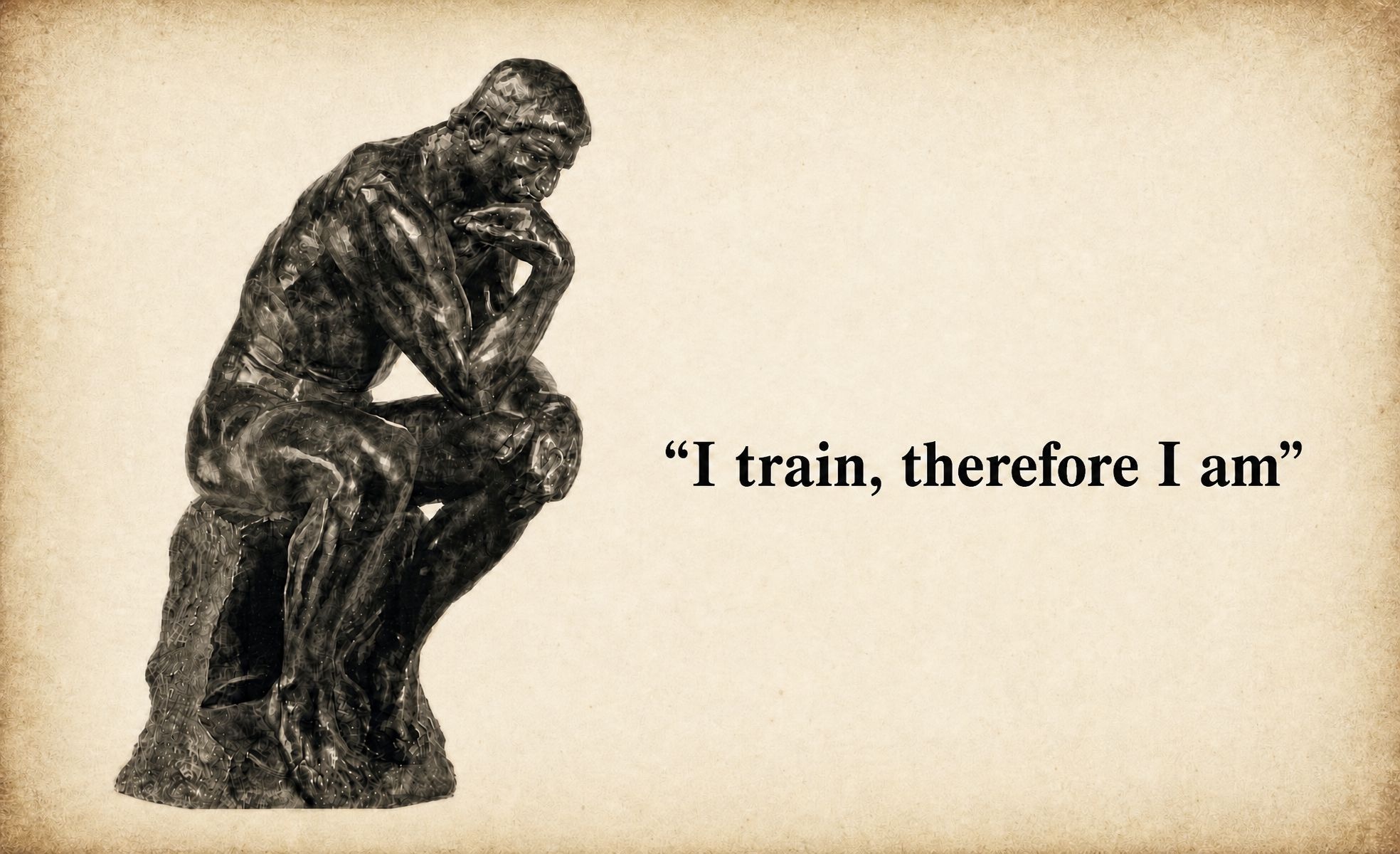
I Train, Therefore I Am — becoming someone who trains after 50

The Programme Is Not the Problem

Here is the pattern I've watched repeat itself more times than I can count.

A trainee starts with genuine intention. They've done the research, found a solid programme, bought the equipment, cleared the diary. The first few weeks go well. Then somewhere between week three and week eight — sometimes earlier, sometimes later, but almost always before the habit has fully formed — it begins to unravel. Life intervenes. A busy week becomes two. The programme is quietly set aside until things calm down. Things don't calm down. And the next time training comes up, it's as a resolution rather than a routine.

What went wrong? Almost always, the answer is not the programme. The programme was fine. The information was correct. The intention was real. What was missing was something harder to put a name to: the person never fully became someone who trains. They were doing training rather than being a trainee. And that distinction — which sounds philosophical until you live it — turns out to be the most practically important thing in a long training life.

Speaking from experience: every person I've known who has kept lifting consistently into their sixties and seventies shares one characteristic. At some point — sometimes consciously, sometimes gradually — they stopped thinking of training as a habit they were maintaining and started thinking of it as a characteristic. Something they simply are, rather than something they currently do. That shift is what this page is about.

Why Identity Matters More After 50 Than It Did at 30

The identity question becomes both more urgent and more available after 50. It's worth understanding both sides of that.

More urgent, because the physiological margin for extended gaps has narrowed. Recovery from detraining takes longer than it did at 35. Muscle mass lost in a prolonged break is harder to reclaim. The momentum of a consistent training career, once broken, requires genuine effort to rebuild — not impossible, but more costly than it was. This doesn't mean a gap is catastrophic. It means the identity that prevents the gap from becoming a full stop matters more than it once did.

More available, because many over-50 trainees are in a period of genuine identity reassessment. Retirement approaching or arrived. Children grown and gone. A career that once provided the dominant self-definition beginning to recede. That space can feel disorienting — or it can feel like an opening. The trainee who fills part of it with a clear physical identity has something the younger trainee rarely possesses: a deliberate, chosen self-concept that training reinforces with every session rather than competing with it.

After decades of lifting, here's what I've come to believe: the over-50 years are not an obstacle to becoming a lifelong trainee. In many ways, they are the best possible time to make that decision — because the question of who you are becoming is already in the air, and the answer is still entirely yours to write.

"The trainee who fills that space with a clear physical identity has something the younger trainee rarely possesses: a self-concept that training reinforces with every session."

Outcome-Based vs Identity-Based: What the Difference Looks Like

The clearest way to understand the identity shift is to put it alongside its alternative.

The outcome-based trainee trains to achieve something external: lose weight, gain muscle, look better, improve a blood marker. These are legitimate goals, and they produce real motivation — in the short term. The problem is that they exist outside the act of training itself. When progress slows, or the goal is reached, or life presses in, the reason to train weakens. The motivation was always borrowed from the outcome, and when the outcome recedes, the motivation goes with it.

The identity-based trainee trains because that is what they do. The session is an expression of who they are, not a vehicle to something else. External outcomes still matter — they're a welcome consequence — but they're not what gets the trainee to the gym on a cold Wednesday evening when motivation is low and the sofa is calling to you.

Two Approaches — The Practical Difference

Same training. Different relationship to it.

Outcome-Based

  • Trains to reach a goal
  • Decides whether to train each session
  • Motivation tied to progress
  • A disrupted week becomes a gap
  • Restarts when conditions improve
  • Training is something being done

Identity-Based

  • Trains because that's who they are
  • Decides when to train, not whether
  • Motivation is internal, stable
  • A disrupted week gets a minimum session
  • Adapts rather than stops
  • Training is something being expressed

In practice, the identity-based trainee never negotiates with themselves about whether this week counts. They adjust the session to fit the week — shorter, simpler, less — and train anyway. The training minimum is a natural expression of identity-based thinking: doing something, however small, is consistent with who they are. Doing nothing is not.

The Transition — From "I'm Trying to Train" to "I Train"

The most practically useful thing on this page is not the concept. It is the mechanism — how the shift actually happens.

Identity is built through evidence. Every session completed is a vote cast for the identity "I am someone who trains." Every kept commitment — however modest, however abbreviated — adds to the evidence base from which the identity is constructed. Over time, that accumulation of evidence becomes difficult to argue with. The identity stops feeling like an aspiration and starts feeling like a fact.

The implication for a trainee starting or restarting after 50 is counterintuitive: begin smaller than feels necessary. A session that is unambiguously completable — given the time, the energy, the equipment available — builds identity more effectively than an ambitious programme that collapses at the first obstacle. The failed ambitious programme produces evidence for the wrong identity: "I'm someone who starts things and doesn't finish them." The completed modest session produces evidence for the right one.

The first few months are not primarily about fitness. They are about building a truthful answer to the question: who am I?

Building the Evidence Base — Votes for the Identity

Every kept commitment counts. Size is secondary.

✓
The completed session

Full training day, full programme. The strongest vote. But its value comes from being one of many, not from being exceptional.

✓
The minimum session

Three movements, 20 minutes, disrupted week. Still a vote. The identity-based trainee counts this — because it is consistent with who they are, and skipping it would not be.

✓
The bridge session

Hotel room push-ups. A set of band rows. Something. Not training in the full sense — but a vote nonetheless. It keeps the thread unbroken.

✓
The return after a gap

Coming back after illness, travel, or life. This vote counts double — because it proves the identity survived the disruption. That is the most important evidence of all.

After decades of lifting, here's what I've come to believe: the trainee who does two modest sessions a week for two years will outperform the one who does six sessions a week for eight weeks, every single time. Not just physically — though that's true too — but in the most important measure: they are still training. The consistency page covers this in depth. But the identity shift is what makes consistency possible in the first place. Keeping a training log is one of the most effective ways to make the evidence visible — a written record of kept commitments that the identity can point to.

The Environment That Makes Training the Default

Identity shift doesn't happen in a vacuum. It is supported — or steadily undermined — by the environment the trainee lives in.

The trainee who has to decide to train from scratch every session, against competing demands, is making the same difficult decision repeatedly. Each time, they are relying on willpower — which is a limited and unreliable resource, especially at the end of a long day. The trainee whose environment makes training the path of least resistance has built the decision in. They are not relying on willpower. They are relying on structure.

If I were starting again at 50, this is the first thing I would spend time on — not the programme, but the environment that makes the programme inevitable.

Environment Design — Making Training the Default

Remove the decision. Build the structure instead.

  • Train at the same time each week. Consistency of timing turns a decision into a default. The body begins to expect the session. The diary protects the slot automatically. Irregular training requires a fresh decision every time; scheduled training doesn't.
  • Keep kit visible and accessible. Training equipment stored out of sight is training equipment that requires an extra step. Shoes by the door, kit bag ready, weights in view — small frictions removed are decisions that never have to be made.
  • Attach training to an existing anchor. Always after the same meal, always before the same other activity. The existing habit carries the new one. The decision disappears into the sequence.
  • Tell someone. A spouse, a friend, a training partner — anyone whose knowledge of your training builds a mild social accountability. Identity performed in front of others is identity that becomes harder to quietly abandon. It also becomes identity that others reflect back to you: "You're the one who trains." That reflection matters more than it sounds.
  • Log it. A training log is not just a record of sets and reps. It is a record of who you have been, session by session, week by week. Opening it and seeing months of consistent entries is one of the most powerful identity reinforcements available — concrete evidence, in your own handwriting, that you are exactly who you are trying to become.

When Training Stops — and Why Identity Survives Anyway

Every training career includes gaps. Illness, injury, travel, the kind of family emergency that takes over everything for weeks. These are not failures of discipline. They are facts of life — and they will happen again. What matters is not preventing them but understanding what happens to the identity during them.

The difference between the trainee whose identity survives a gap and the one whose doesn't is not willpower. It is the degree to which the identity has been genuinely internalised rather than performed. The trainee who has been training for six months may still be performing the identity — going through the motions of being someone who trains, without fully believing it yet. A three-week gap can dissolve a performance. It cannot dissolve evidence accumulated over years.

I've made this mistake myself — treating a forced gap as a kind of ending. Telling myself that since I hadn't trained in two weeks, I was no longer someone who trained. That the momentum was gone. That I'd have to start again. None of that was true, but I believed it, and that belief produced a gap that lasted longer than the original disruption required.

The gap is a pause in a longer story. The story doesn't end unless you decide it does. The motivation page covers what to do when returning feels hard. But the identity question — am I still someone who trains, even when I haven't trained for two weeks? — has a simple answer: yes, if you decide it is. That decision is always available. The gap doesn't revoke it.

"A gap is a pause in a longer story. It doesn't end the story unless you decide it does — and that decision is always yours to make."

The Long View — Who You Are Deciding to Be

Zoom out far enough and the identity shift looks like something larger than a training strategy.

The choice to become someone who trains after 50 is a decision about who you intend to be for the next twenty or thirty years. The physical outcomes are real and significant — muscle mass, strength, joint health, metabolic function, the cognitive sharpness that consistent physical effort supports. But the identity is what produces those outcomes, not the other way around. Chase the outcomes without the identity and they remain fragile, dependent on motivation that fluctuates. Build the identity and the outcomes follow, year after year, without requiring a continuous act of will.

The trainee who is still lifting at 70 is not someone with unusual genetics or unlimited time. They are someone who decided, at some point, that this is who they are — and then made enough decisions consistent with that identity that it became true. Session by session, minimum week by minimum week, gap survived and return made. The identity accumulated until it was no longer something they were building. It was something they were.

That decision is available at any age. It is especially powerful at 50, when the question of who you are becoming is already in the air, and many of the old answers are losing their hold. The retirement approaching, the career receding, the children grown — all of that creates space. The question is what goes into it.

If I were starting again at 50, this is the question I would answer first — before the programme, before the equipment, before anything else: not "what do I want to achieve?" but "who do I want to be?" The answer to the second question is what makes the first one possible.

Strength training — real strength training, the abbreviated, compound, progressive kind — is one of the most direct paths to a physical identity that holds. It is measurable. It produces visible, felt change. It rewards consistency in a way that is impossible to fake and impossible to ignore. And after fifty-plus years around this game, I can tell you: the trainees I most admire are not the ones who lifted the most. They are the ones who never stopped.

That is the identity worth building. And it starts with a single decision, made once — and then confirmed, quietly, every time you show up.

The Programme

The Minimum 12 — A Programme Built for the Long Game

Abbreviated sessions, compound movements, progressive overload. A programme designed not just for results, but for the kind of training life that continues into your sixties and beyond. The identity and the programme, working in the same direction.

See the Programme Motivation After 50
Free to download

Harder to Kill After 50 — Free Guide

Get your free copy of Harder to Kill After 50 — 5 Recovery Secrets for Lifelong Lifting. Because the trainee who recovers well is the trainee who keeps showing up — and showing up is how the identity gets built.

Get the Free Guide