Perhaps That Was Our Catch
Field of Dreams, My Father, and the Strength We Carry Forward
Of everything Robert has written for the Archive, this is my favourite. I say that without hesitation and without qualification.
I come from a close family myself, so this one resonated in a way I did not entirely expect. The image of Robert's father moving his family up that dark embankment — not fixing the tyre first, but fixing them first — I felt that. The squall on Peconic Bay, the words before the surgery, the catch that turned out to have been going on all along. Robert has written something here that is genuinely moving, and it earns every word.
What connects it to the Iron Game is not incidental. The faith required before the results appear, the field you build without knowing whether anything will come — Robert finds the metaphor and holds it steady through the whole piece. Read it slowly. The ending is something else.
There are some decisions in life that make perfect sense on paper.
And then there are the decisions that make sense only to the heart.
In Field of Dreams, Ray Kinsella hears an inexplicable voice across an Iowa cornfield: "If you build it, he will come." He responds by doing something that, viewed purely through the cold mathematics of practicality, seems absurd. He plows under part of his cornfield, builds a baseball diamond, and waits.
There is something about that story that has always spoken to me.
Some of the things that make the least sense on a spreadsheet can make the greatest sense to the human heart.
Building the Field
Perhaps that is because the Iron Game asks us to practice a similar kind of faith.
Walk into an empty garage, basement, or spare room and place a barbell on the floor. Add a bench, a rack, some plates, perhaps a chalk bowl sitting quietly in the corner. To someone else, it may look like nothing more than a collection of iron.
But you know what it can become.
You build the space. Then you show up. Again and again.
Long before there is visible evidence that anything is changing, you believe the work matters. You add a little weight when you can. You perform another repetition. You eat. You rest. You return. Gradually, almost imperceptibly, something begins to emerge from what appeared to be an empty field.
Strength.
But Field of Dreams reaches much deeper than baseball. It is a story about memory, reconciliation, fathers and sons, second chances, and the mysterious way the past continues speaking to us long after we think we have left it behind.
That is where the movie and the Iron Game come together most powerfully for me.
I have spent much of my life surrounded by pieces of physical culture's past — old magazines, books, courses, photographs, equipment, and the writings of men whose voices helped shape generations of lifters. To someone unfamiliar with that world, they might simply look old.
I see something else.
I see people. I see lessons. I see history. I see a torch being passed from one generation to another.
Perhaps, without realizing it, I have been building my own field all these years. Not a baseball diamond surrounded by Iowa corn, but a place where the old Iron Game can walk out of the shadows once again — where the wisdom of yesterday can speak to someone training today, where names that might otherwise disappear can be remembered, and where preserving the past does not mean refusing to move forward.
It means deciding what deserves to come with us.
When Dad Said We'd Be All Right
But there is another reason Field of Dreams touches me so deeply.
And it has nothing to do with baseball.
Or perhaps it has everything to do with baseball.
It has to do with fathers and sons. I think I first understood my father's ability to make me feel safe when I was about eight years old.
Our entire family was packed into our old green Chevy station wagon — Mom, Dad, my four sisters, and me. We were returning home to Syosset after visiting my grandparents in Larchmont, New York. It was already dark when we were traveling along the Northern State Parkway.
Then we got a flat tire.
There was nowhere nearby to exit and no breakdown lane where Dad could safely pull over. He maneuvered that big green Chevy onto an embankment, leaving the car sitting at an angle. Traffic continued rushing past us in the darkness.
We were frightened. Mom was frightened too, although she did her best to comfort us. My two younger sisters began crying.
Dad knew his first responsibility wasn't the tire. It was us.
He moved the entire family farther up the embankment, putting as much distance as possible between us, the car, and the fast-moving traffic. Then he gathered all of us together in a group hug and told us everything was going to be all right.
And we believed him.
Not because the situation had suddenly become less dangerous. Not because the flat tire had magically repaired itself. We believed him because Dad said it.
Once he knew we were safely away from the road, he returned to the station wagon and changed the tire. The driver's-side rear of that big green behemoth sat only about five feet from the traffic whizzing past him.
He changed the tire. He got his wife and five children safely back into the car. And then Dad drove his family home.
No great speech. No celebration. Just a father doing what needed to be done.
But to an eight-year-old boy watching from that embankment, something important had happened.
Dad had said we were going to be all right. And we were.
The Storm
Five years later, I would hear that reassurance again.
This time there would be no green Chevy station wagon, no Northern State Parkway, and no family huddled on an embankment. There would be only Dad and me in a nineteen-foot sailboat on Peconic Bay — and a storm coming toward us.
It was 1970. Our family was vacationing in Greenport, on the North Fork of Long Island, when Dad and I decided to go sailing. Sailing was part of my father's life. My grandfather had started the yacht design and marine brokerage firm Sparkman & Stephens in 1928, and Dad went to work there as a young man. He would remain with the company for nearly fifty years before retiring. He had also been an avid sailor throughout his life.
Dad rented a Rhodes 19 daysailer, and the two of us set out onto the bay.
For quite a while, everything was fine.
Then Dad noticed the sky.
Dark, heavy, low-hanging clouds were gathering on the horizon. He knew what they meant. We needed to get back.
The squall approached rapidly. The wind intensified. Whitecaps began appearing across the bay, and the waves grew larger.
I was frightened.
But Dad remained calm. He reassured me that everything was going to be all right, and there was such conviction in his voice that I believed him.
If Dad said we were going to be all right, we were going to be all right.
He roller-reefed the mainsail to reduce sail area in the increasingly fierce wind and continued working us toward safety.
I watched him. No panic. No theatrics. Just experience, concentration, and the absolute determination to get his son safely home.
We finally pulled alongside the dock. And then the sky opened. Rain came down in a deluge. Thunder cracked. Lightning flashed.
But we were back. We were safe.
Once we had gotten inside and dried ourselves off, I told Dad what I had been thinking throughout the ordeal.
I told him he was fearless.
His answer has stayed with me ever since.
Dad told me that he had been scared. But he knew he had to get me safely out of that storm.
I think I loved and respected him even more after hearing that. Because at thirteen years old, I learned something about courage that I wouldn't fully understand until much later.
Courage isn't the absence of fear. Sometimes courage is being every bit as frightened as the person beside you — and becoming the calm they need anyway.
Dad had gotten both of us safely through the storm. But he had given me something else that day too.
He had shown me what strength looked like.
The Strength My Father Saw
Years later, my mother once told me that she wished Dad had spent more time with me when I was growing up. She wished he had attended more of my Little League games and shared more of those traditional father-and-son moments.
I understood what Mom meant.
But I told her something I meant with all my heart: I didn't need him to.
I never measured my father's love by the number of baseball games he attended. By the time I was thirteen, I already knew something about Dad that mattered far more to me.
When life became frightening, he didn't disappear. He became the person everyone else could depend upon.
Dad wasn't larger than life to me because he was fearless. He was larger than life because when the people he loved were afraid, he made them feel safe.
Then, when I was in my late twenties, Dad said something to me that I have carried ever since.
By then, strength had already become an enormous part of my life. I had spent years beneath barbells, adding weight to the bar, building my body, and discovering how far I could push myself. My father knew that.
One day he told me that I was the strongest person he had ever known.
Then he made sure I understood what he meant.
He wasn't talking only about my physical strength.
Even now, all these years later, I can feel the weight of those words.
For a young man who had devoted so much of himself to becoming physically strong, hearing my own father tell me that he saw another kind of strength inside me meant more than another plate on a barbell ever could.
Dad saw something in his son.
And he told him.
What a gift that was.
I have lifted a great deal of iron in my lifetime. I have forgotten the exact weight of countless barbells. I have forgotten sets, repetitions, workouts, and numbers that once seemed enormously important.
But I have never forgotten those words. And I never will.
The Day the Catch Came Back
Many years later, the roles began to change.
It was 2010. Dad had suffered a heart attack and needed open-heart bypass surgery.
Shortly before they wheeled him into the operating room, he pulled me close. There was something he needed to ask me.
Dad wanted to know that if something happened to him during the surgery, I would take care of Mom.
Of course I would.
I reassured him that I would be there for her, no matter what happened.
Dad told me that he had always known that.
But he needed to hear me say it.
All those years earlier, when I was an eight-year-old boy standing frightened on an embankment beside the Northern State Parkway, Dad had gathered his family together and told us everything was going to be all right.
We believed him.
At thirteen, when the wind howled across Peconic Bay and the waves rose around our little sailboat, Dad again reassured me.
I believed him.
And now, decades later, my father was the one facing something frightening.
This time, he needed to hear those words from me.
I told him not to worry. I would take care of Mom. I would be there.
Dad and I hugged. I kissed him on the forehead. And we both said, "I love you."
Then they wheeled my father into surgery.
Thankfully, Dad came through the operation. When he was awake and able to receive visitors, he told me something I will never forget.
My words had helped him get through it.
The father who had once given his frightened little boy strength now found some of the strength he needed in his son.
It was my turn to help Dad through the storm.
The Highest Honor
As Mom and Dad grew older, there would be other times when they needed me. And I was profoundly grateful that I could be there.
By then, however, I wasn't standing alone.
Nancy was beside me.
She helped me care for my parents. She helped shoulder the responsibilities. And during some of the most difficult moments, when my own strength was being tested, she gave me some of hers.
There is a quotation attributed to Tia Walker that expresses something I have come to believe deeply:
"To care for those who once cared for us is one of the highest honors."
I know exactly what that means now.
Caring for Mom and Dad never felt like repaying a debt.
Love doesn't keep that kind of accounting.
It felt like an honor.
They had carried me when I needed carrying. And when the time came, I was blessed to help carry them.
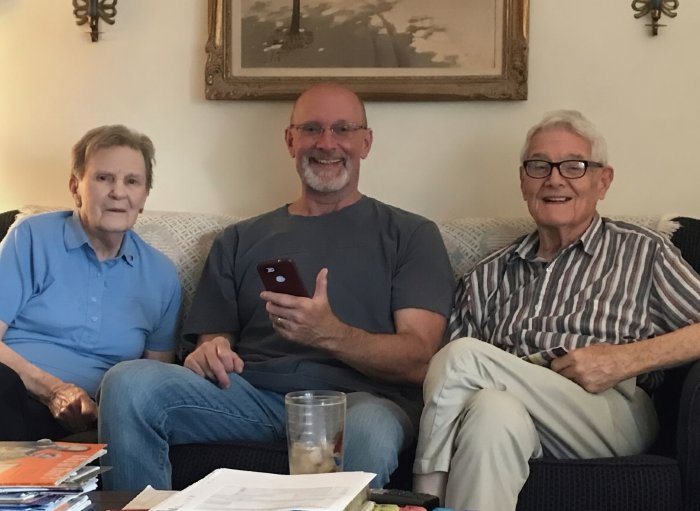
Perhaps That Was Our Catch
Near the end of Field of Dreams, Ray Kinsella is given the opportunity to do something wonderfully ordinary with his father.
Have a catch.
No grand speech. No attempt to recover every lost year. Just a father, a son, a baseball, and a little more time.
My father and I didn't need that particular catch.
Ours came in other forms.
The older I become, the more I understand that fathers don't always teach their greatest lessons intentionally.
Sometimes they teach them while changing a tire beside a dark highway.
Sometimes while steering a small sailboat through a squall.
Sometimes through a few words spoken to a grown son that the father may never realize will be remembered for the rest of his life.
And sometimes, if we are fortunate, life eventually gives the son an opportunity to return what he was given.
Perhaps there wasn't one catch. Maybe Dad and I had been playing catch all along.
A frightened little boy received reassurance from his father beside a dark highway. Five years later, another throw came across the waters of Peconic Bay. Years afterward, Dad tossed a few words toward his grown son: I was the strongest person he had ever known.
And eventually, when Dad needed reassurance before being wheeled into surgery, something came back in the other direction.
I caught what he had given me — and when the time came, I threw it back.
Maybe that's what fathers and sons do.
They throw something precious across the years and hope the other person catches it.
Courage.
Responsibility.
Strength.
Love.
My father threw those things to me long before I understood what he was giving me. Eventually, life gave me the privilege of throwing some of them back.
Perhaps that was our catch.
And perhaps it lasted a lifetime.
What We Carry Forward
Maybe that is why we build our fields.
We build them so the things that mattered are not lost.
We preserve the photographs. We save the old magazines. We tell the stories. We remember the people who taught us. We pass along what they gave us.
Not because we are trying to live in yesterday, but because love deserves a way to travel into tomorrow.
Ray built a baseball diamond.
I've spent a lifetime building mine with iron, words, memories, and the people I have been blessed to know.
A father's greatest legacy may not be what he leaves to his son. It may be what he leaves inside his son.
My father is gone now, but I am still carrying what he threw to me.
Every lesson. Every memory. Every word.
Especially the words I will never forget:
"You are the strongest person I have ever known."
Dad wasn't talking about the barbell.
It took me a lifetime beneath one to fully understand what he meant.
Some of the things that make the least sense on a spreadsheet can make the greatest sense to the human heart.
You simply prepare the ground.
You do the work.
You keep the faith.
And you leave the gate open.
Because the things we carry forward may become the very things that carry someone else.