How to Train When You're Ill, Injured or Exhausted After 50
Not well enough to train hard. Not ill enough to justify stopping. The grey zone is where most training programmes quietly fall apart — here's a practical guide to navigating it
By Lee Driver · Ordinary Joe Muscle Building
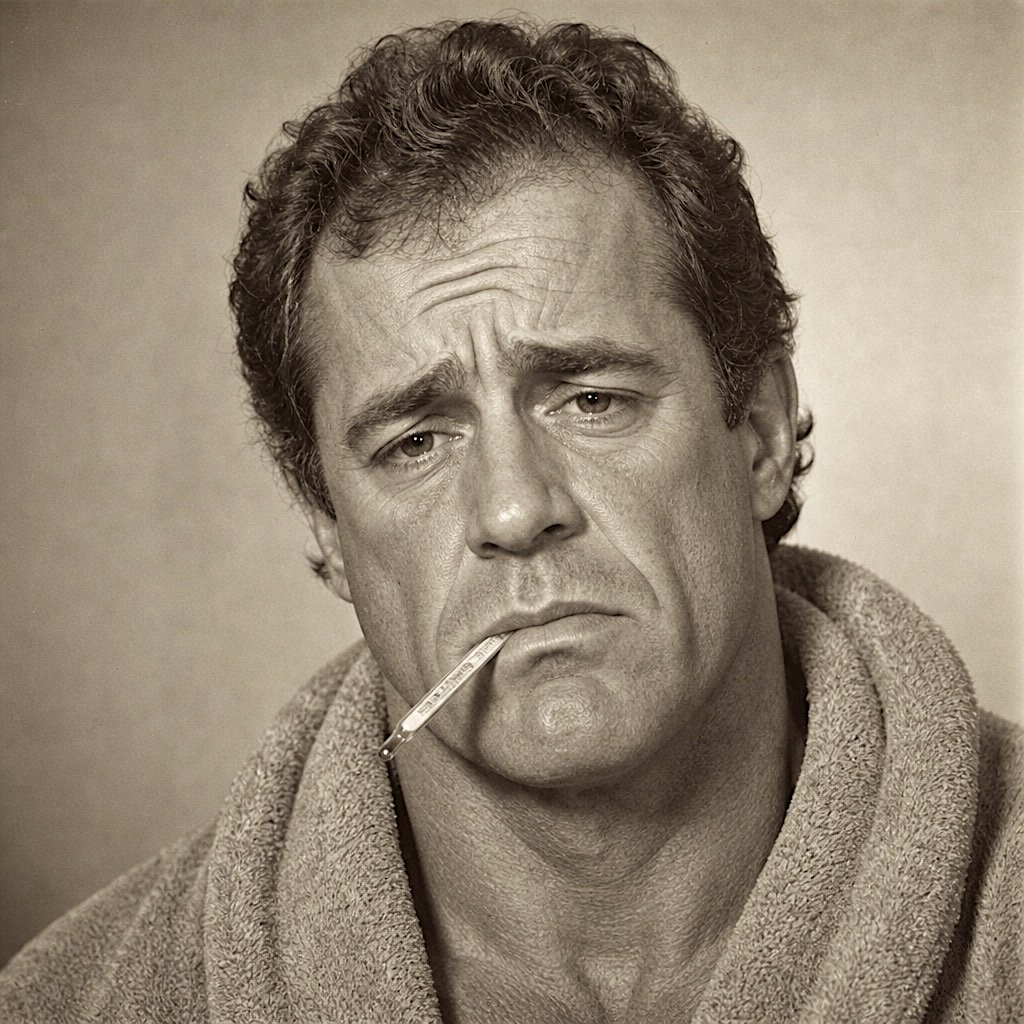
Every experienced trainee knows the feeling. A scratchy throat, a restless night, a nagging ache that's been there for three days without getting worse. You're not well enough to train as planned. You're not ill enough to justify doing nothing. The session is due. You stand in the kitchen at 7am holding a cup of tea and you genuinely don't know what the right call is.
This is the grey zone. Nobody talks about it directly — not in training books, not in programme guides — and yet every real trainee lives there repeatedly. After 50, you live there more than most. Minor illnesses linger slightly longer than they used to. Recovery from hard sessions takes more out of you. The cost of a week off feels higher because you know, at this stage of life, that consistency is the variable that matters most. And so the grey zone decisions carry real weight.
The standard advice is to "listen to your body." I've heard this said by coaches and read it in countless articles, and I want to be honest with you: it's nearly useless. When your body is sending mixed signals — tired but not feverish, achy but not injured, flat but not broken — it's not speaking clearly. Listening harder doesn't help. What you need is a framework for interpreting the signals correctly, and then acting on that interpretation with some confidence.
That's what this page is. Not a permission slip to skip training whenever you feel less than perfect. Not a demand that you push through everything regardless. Just a practical, honest guide to the grey zone — the place where, after decades of navigating it myself, I've found that getting the decision right makes more difference to long-term consistency than almost anything else.
The neck check — a useful starting point, but only a starting point
The most widely cited rule for training when ill is the neck check: symptoms above the neck (runny nose, mild sore throat, sneezing) — train cautiously at reduced intensity. Symptoms below the neck (chest congestion, fever, body aches, gastrointestinal illness) — rest completely.
It's a reasonable first filter. The physiological reasoning behind it holds up. Training with a chest infection or a fever genuinely suppresses immune function and extends recovery time rather than shortening it. Hard training — even moderate training — at the wrong moment increases circulating stress hormones and pulls resources away from the immune response that's trying to do its job. This is not gym mythology; it's what the evidence on training and immune function over 50 consistently shows.
But the neck check breaks down at the edges. What about the trainee who has no visible symptoms but feels genuinely flat — bone-tired in a way that doesn't come from one bad night's sleep? What about the persistent low-grade something that arrives in October and lingers for six weeks without ever becoming a proper illness? What about the exhaustion that follows a run of sustained life stress — the kind that sits in the body differently from physical fatigue?
After decades of lifting, here's what I've come to believe: the neck check tells you when to definitely not train. It doesn't reliably tell you when to train. For the grey zone — the territory between clearly fine and clearly unwell — you need more nuance than a single binary rule provides. So let's go through the three distinct situations separately.
When you're ill — the practical decision framework
Illness is the most straightforward of the three grey zone situations, because the physiology is clearest. The immune system is working. Your job is not to interfere with it.
Hard training while fighting even a mild illness is almost always the wrong call, not because it will cause a catastrophe but because it reliably extends recovery time. A cold that would resolve in five days if you rested properly can drag on for ten if you push through a full session in the middle of it. I've made this mistake myself — convinced that the session would help, that moving would shake it off — and it never worked. The body has a hierarchy of priorities, and when it's dealing with a pathogen, training stimulus is not near the top of the list.
What the signal actually means — and what to do with it
- Mild above-neck symptoms, no fever, energy present Train at half intensity. Same movement patterns, half the volume, no new maximal efforts. Shorter session. Aim to finish feeling neutral — not depleted.
- Moderate symptoms, energy low but functional Easy movement only. A walk, some light mobility work, gentle movement. No training session. This is rest with movement, not a workout.
- Fever present — any temperature Rest completely. No exceptions. Training with a fever is genuinely counterproductive and carries real risk. Wait until 24 hours after the fever breaks before reassessing.
- Below-neck symptoms (chest, stomach, full-body aches) Rest completely. The neck check applies directly here. Pushing through chest illness or gastrointestinal sickness has no upside and real downside.
- Recovering — symptoms cleared, energy not yet back One reduced session before full return. Don't jump straight back to where you left off. A single lighter session acts as a test before resuming normal programming. See the reduced session template below.
A useful prompt: could you walk for 30 minutes right now without feeling worse? If no — rest. If yes — a reduced session is probably on the table. The question isn't "am I capable of training?" It's "will training help or hinder what my body is already doing?"
The return question is where many trainees get this wrong. After even a short illness — four or five days — there's a temptation to pick straight back up at the weight and volume you left off at. Resist it. A single reduced session before resuming your normal programme is a small investment that buys you a week of smooth progression instead of a week of struggling through sessions your body isn't ready for yet.
When you're injured — training around vs training through
Injury is where the most important distinction in this entire page lives, and it's one that's worth stating as plainly as possible.
Training around an injury means modifying the programme to protect the affected area while continuing to train everything else. It is almost always the right approach. Training through pain means ignoring signals from the body and loading an area that is telling you not to. It is almost always the wrong approach, and after 50 it carries consequences that take considerably longer to resolve than they did at 35.
The mistake I see most often — and I've made it myself — is all-or-nothing thinking. The shoulder is sore, so training stops entirely. The knee is complaining, so the whole programme gets shelved. This is understandable; when something hurts, the instinct is to rest everything. But a sore shoulder does not stop you squatting, hinging, or performing lower body work. A sore knee does not stop you pressing, rowing, or training your upper body. The injury affects one area; the rest of the body is fully available.
"The trainee who trains around an injury for three weeks comes back whole. The trainee who stops entirely for three weeks comes back deconditioned, and still has the injury."
Training around injury after 50 is a skill worth developing deliberately, because at this stage of training life you will use it repeatedly. Tendons and connective tissue in particular become more demanding of careful management after 50 — they adapt more slowly than muscle does, and they respond badly to being either ignored or completely rested. Gentle, appropriate loading through a modified range often accelerates recovery faster than complete immobilisation.
The signal to watch for is the nature of the pain. Discomfort during warm-up that resolves within the first few sets — often called "warm-up pain" — can frequently be trained through carefully, with reduced load and attention to form. Sharp, worsening, or localised pain that increases during the session is the body telling you something specific and worth hearing. When in doubt about anything structural — a joint, a disc, a tendon that's been deteriorating for weeks — the right call is a brief conversation with a physiotherapist, not a visit to the forum. Returning to training after injury has its own guide here; this page is about the earlier, grey zone stage when you're still working out what you're dealing with.
When you're exhausted — the most misread signal of all
Exhaustion is the grey zone situation I find most interesting to think about, because it's the one where the right answer varies most dramatically depending on what kind of exhaustion you're actually dealing with.
There are at least three different things that "I'm exhausted" can mean, and they require entirely different responses.
The first is ordinary tiredness — a poor night's sleep, a demanding week at work, the general low-level fatigue that is simply part of adult life. This kind of tiredness, in my experience, usually responds well to training. Not hard training; not a PR attempt. But a session at a slightly reduced intensity, moving through familiar patterns, will often leave you feeling noticeably better than you did when you arrived. The fatigue lifts during the warm-up, the body warms to the work, and you leave in a better state than you entered. If this is where you are, train.
The second is accumulated fatigue from overreaching — the kind that builds when the training load has exceeded what the body can recover from over a run of weeks. The diagnostic here is specific: the session makes you feel worse, not better. You arrive tired, you train, and you leave more tired. Performance is flat or declining across multiple sessions. Overreaching and overtraining after 50 is a real phenomenon — one the older trainee is more vulnerable to, partly because recovery capacity decreases with age and partly because the warning signals are more muted. A deload week resolves this reliably; pushing harder through it does not.
The third is genuine systemic exhaustion — the kind that follows illness, grief, prolonged disrupted sleep, or sustained life stress over weeks or months. This is categorically different from ordinary tiredness, and it's the one most commonly mismanaged. After decades of lifting, here's what I've come to believe about this category: the body in genuine systemic exhaustion is not merely underperforming. It is signalling that something more fundamental needs attention. A full training session — even a reduced one — may be genuinely too much to ask of it right now.
The hard truth about sleep and recovery is that no training programme performs well on top of chronic sleep disruption or sustained stress. The sessions go in; the adaptations don't come out. This isn't a failure of willpower. It's physiology. The stimulus is present; the recovery environment is absent. In this situation, the most productive training decision is sometimes to rest more deliberately, address the underlying cause where possible, and return to the programme when the foundation is in better shape.
What a reduced session actually looks like
The phrase "train at reduced intensity" appears throughout this page and in most sensible training advice, and it's worth being concrete about what it actually means in practice — because the version many trainees execute is not really reduced at all. They start with good intentions, warm up, start feeling better, and slide naturally into a full session. I've done this myself more times than I can count.
A genuine reduced session has a specific character, and it's useful to commit to its parameters before you start, not in the middle of it.
- Half the volume. If your normal session is three sets of four exercises, the reduced session is two sets of the same four exercises — or three sets of two exercises. Not "I'll see how I feel." Decide before you start.
- Half the intensity. Working weight at 50–60% of your normal load. This is not a day for anything near a maximal effort. The goal is movement, not stimulus.
- Same movement patterns, no new exercises. Familiar movements only. A grey zone session is not the day to add a new exercise or attempt a variation you've never done before.
- No PRs attempted. If a weight feels surprisingly easy, leave it. A grey zone session that ends at the weights you planned is a success. One that ends at a new maximum is a risk that wasn't worth taking.
- Longer rest periods, not shorter. Rest fully between sets. The impulse to keep moving, to compensate for the reduced volume with density, is counterproductive here. Rest properly and keep the session quality high.
- The success condition is arriving home feeling neutral or better. Not depleted. Not worse. If you finished the session and feel approximately the same as when you arrived — perhaps slightly better — the session achieved its purpose: maintaining the habit and the movement without costing the body more than it had to spend.
A 25-minute reduced session is more valuable than a cancelled week when the goal is long-term consistency. The abbreviated training principle applies here directly: doing less, but doing it consistently, produces better results over a decade than doing more intermittently.
The thing that matters most about a reduced session is not what's in it — it's that it happened. The habit of showing up, even at a fraction of full capacity, is more valuable than the training stimulus it produces. Every trainee who stays in the game for twenty years has a relationship with the grey zone. The ones who navigate it consistently are the ones who give themselves a version of training that doesn't require being fully well to execute.
The grey zone is a skill — and it's worth developing deliberately
Here is the perspective I want to leave you with, because I think it reframes the grey zone from a problem into something more useful.
The trainee who handles imperfect conditions well — who modifies rather than stops, who returns promptly rather than waiting for perfect health, who learns to read their body's signals accurately — accumulates dramatically more training over a decade than one who uses anything less than full readiness as a reason to pause.
Missing a week of training occasionally is physiologically irrelevant. The body doesn't forget. Strength returns quickly after a brief absence; muscle is not lost in days. Forced time off is less damaging than most trainees fear. But missing a month every time life presents imperfect conditions — every winter illness, every stressful quarter at work, every period of disrupted sleep — is where long-term results genuinely diverge. The trainees who are still going strong at 65 and 70 are almost universally the ones who learned to navigate the grey zone without treating it as a reason to stop.
"If I were starting again at 50, this is what I'd prioritise: not the programme, not the diet, not the supplements. The ability to keep showing up in imperfect conditions. That's the variable that separates a training career from a series of interrupted attempts."
The grey zone is not a failure state. It is a normal, recurring feature of a long training life. Learning to navigate it — illness, injury, exhaustion, the murky territory between — is part of becoming a durable, experienced trainee. Staying consistent after 50 is, in large part, the story of how you handle the weeks when everything isn't ideal.
Most of them won't be ideal. Train anyway — just less, and more carefully, on those days.
The Minimum 12 — Built Around Consistency, Not Perfection
A twelve-week programme designed around two sessions a week and four compound movements. Brief enough to run on difficult weeks. Progressive enough to produce real results over time. Built, specifically, for the long game.
See the Programme Training ConsistencyHarder to Kill After 50 — Free Guide
Join over 700 subscribers and get your free copy of Harder to Kill After 50 — 5 Recovery Secrets for Lifelong Lifting. Practical experience-based guidance on staying durable, consistent, and in the game for the long term.
Get the Free Guide