Bicep Routine —
Matthias Schlitte
and the Abbreviated
Arm Workout
Super-slow training, partial repetitions, and four exercises — the abbreviated arm routine that works in two weeks
Building bigger arms does not require endless curl variations and dedicated arm days. It requires the same quality of stimulus — applied with the same intelligence — that produces results on any other muscle group. High tension, controlled movement, adequate recovery, and progressive loading.
The four-exercise routine on this page combines two underused training techniques into a concentrated two-week protocol. The story it begins with is a lesson in what happens when the right implement meets the right trainee — however unlikely that combination appears.
A 140-pound teenager, a German bar,
and an 18-inch forearm.
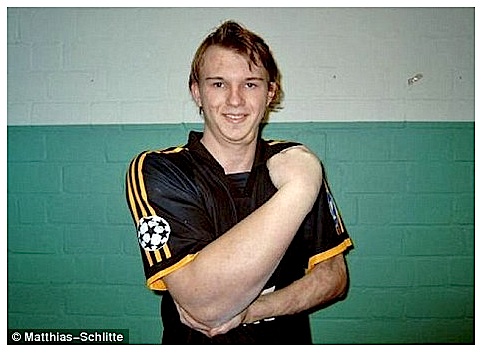
Picture a crowded German bar hosting a local arm wrestling tournament. In off the street walks a 16-year-old weighing 140 pounds. The established competitors barely register his arrival — a scrawny teenager with no apparent physical credentials. They are wrong to dismiss him.
Matthias Schlitte was born with a genetic condition that produced a forearm almost 18 inches in circumference — an extraordinary structural advantage in a sport where forearm and wrist leverage determines most contests. That afternoon in the bar, the teenager who looked like the least threatening person in the room took on all challengers and beat wrestlers almost twice his size.
The man nicknamed Hellboy by his opponents — the forearm that changed everything.
- Forearm circumference — genetic condition 18 inches
- Bodyweight at first tournament 140 lbs
- Age at first tournament 16
- Career result Multiple world champion
- TV appearance Discovery Channel — "Is It Possible?"
The training lesson from Schlitte is not that genetic advantages determine outcomes — most trainees do not have an 18-inch forearm to work with. It is that identifying the movement pattern and the training approach your specific structure responds to best, and then applying it with complete commitment, produces results that generic programmes cannot match. Schlitte did not try to become a gymnast or a sprinter. He found what he was built for and became the best at it.
The application to arm training is direct. If your structure responds best to chin-ups rather than curls, to partial-range loading rather than full-range pumping work — discover that through deliberate experimentation and then commit to it. The two techniques in the routine below are worth experimenting with for exactly this reason. They produce a stimulus that conventional arm training does not.
The abbreviated approach on this page applies the same minimum effective stimulus principle as the Minimum Effective Strength System — four exercises, maximum quality, adequate recovery. No junk volume. The same principle that builds total-body strength applied to concentrated arm development.
Super-slow training and partial repetitions —
two underused techniques combined.
The routine is inspired by exercise researcher Ellington Darden's Stage Reps concept, adapted into an abbreviated training format. It combines two specific techniques that are individually effective and significantly more powerful in combination.
The first is super-slow training. Moving through a repetition at a deliberate, controlled pace eliminates momentum from the movement entirely — the muscle must generate force throughout the full duration rather than relying on the elastic energy of a faster movement. A moderate weight becomes genuinely demanding because the time under tension is dramatically increased. The muscle works harder for longer with less load.
The second is partial repetitions. Rather than moving through the full range of motion, partial reps target the mechanically strongest portion of the movement — the range where the muscle can generate maximum force under maximum load. Because the leverage is more favourable, heavier resistance becomes possible. The muscle is overloaded in its strongest position with a load it could never handle through the full range.
Combined, these two techniques produce a stimulus that conventional arm training rarely creates — high mechanical tension, sustained time under load, and genuine muscular overload achieved without the joint stress of extremely heavy full-range lifting.
Four exercises over two weeks —
the complete abbreviated arm protocol.
Four workouts. Fourteen days. One measurement before and one after.
- Measure the circumference of your flexed upper arms before the first session and record the number — this is your baseline
- Perform the four-exercise routine every three days for a total of four sessions across two weeks
- This is your only training during the two-week period — no additional sessions of any kind
- After the fourth session rest completely for two days, then remeasure both arms at the same flexed position
- The two-week isolation is not optional — the protocol works precisely because recovery is complete between sessions
-
Super-slow chin-up
Biceps, lats, grip — single rep, maximum duration
Take a shoulder-width supinated grip — palms facing toward you — on a chin-up bar. Begin pulling upward as slowly as possible, aiming for a 30-second ascent from dead hang to chin above bar. At the top, begin lowering at the same controlled pace — 30 seconds down to full extension. This is one repetition.
Trainees capable of six or more standard chin-ups should aim for 30 seconds each way. Those capable of ten or more can attempt 45-second phases. The movement must be continuous — no pausing at the top or bottom. If the tempo breaks down completely, the set is over. The goal is continuous muscular tension throughout the entire range.
-
Partial-rep barbell curls
Biceps — 12 repetitions, bottom half of range
Stand holding a barbell with a shoulder-width underhand grip. Start from the fully extended position and curl the bar upward only to the point where the elbows reach approximately 90 degrees — the midpoint of the movement. Lower and repeat. The bar never reaches the top of a conventional curl and never drops below full extension.
This partial range targets the lower half of the curl — the portion where the biceps is mechanically disadvantaged and the stimulus is greatest. Use a weight that allows 12 clean repetitions in approximately 30 seconds. The movement should be smooth and continuous with no swinging of the torso. All tension remains on the biceps throughout. If the back begins contributing, the weight is too heavy.
-
Super-slow dip
Triceps, chest, anterior deltoids — single rep, maximum duration
Mount parallel bars at arms' length. Begin lowering at the slowest possible pace — 30 seconds to reach the bottom position with elbows at approximately 90 degrees. From the bottom, press upward at the same controlled tempo — 30 seconds back to lockout. That is one repetition.
Keep the torso relatively upright throughout to emphasise the triceps over the chest. The elbows should track directly behind rather than flaring outward. If the tempo collapses before reaching the midpoint, the set ends. The same 45-second option applies for stronger trainees. For full technique guidance on the dip, see the dip exercise page.
-
Partial-rep dumbbell triceps extensions
Triceps — 12 repetitions, top half of range
Hold a single dumbbell overhead with both hands, elbows pointing toward the ceiling. Lower the dumbbell by bending the elbows until they reach approximately 90 degrees — the midpoint of the movement. From there, press back to full lockout overhead. Lower and repeat. The dumbbell never descends below the 90-degree elbow position.
This partial range targets the upper half of the triceps extension — the range approaching full lockout where the long head of the triceps is most actively recruited. Use a weight that allows 12 smooth repetitions. Maintain strict elbow position throughout — the elbows should point directly upward and not drift outward as fatigue accumulates. Twelve repetitions completed with control over approximately 30 seconds is the target.
Four exercises. One session every three days. Four sessions total. Then two days of complete rest before measuring. The protocol works because intensity is concentrated rather than dispersed across endless volume — and because recovery is given the full space it requires to complete the adaptive response the sessions trigger.
Why concentrated intensity
beats dispersed volume for arm growth.
The common assumption in arm training is that more exercises produce more development — that cycling through seven or eight curl and extension variations across a dedicated arm day covers all the angles and produces comprehensive growth. In practice, this approach produces diminishing returns because the cumulative fatigue of high volume undermines the quality of stimulus each individual exercise provides.
The abbreviated approach works on the opposite principle. Four exercises, each performed with maximum attention and control, each targeting a specific quality of muscular stimulus — sustained time under tension, mechanical overload in the strongest range — produce a more concentrated and more productive stimulus than twice as many exercises performed with divided attention and accumulated fatigue.
This is the same principle that drives abbreviated training across the rest of the site — a small number of high-quality efforts with adequate recovery produces more adaptation than a large number of mediocre efforts without it. The arm routine simply applies that principle to a specific and frequently overtrained muscle group.
Concentrated effort, adequate recovery, progressive stimulus — the three operating principles behind this routine and behind the Minimum Effective Strength System equally. Fewer exercises performed better produces more than more exercises performed worse. Arms included.