Building Muscle
After 50 — Mass
Gain Study Results
What Pete Sisco's study found when he put 50-year-old trainees on brief, infrequent workouts
The assumption that serious muscle and strength gains become impossible after 50 is not supported by the evidence. A targeted study by fitness author Pete Sisco — using trainees with a median age of 50 — produced results that challenge everything conventional training wisdom says about age and muscle building.
Here is what happened — and what it means for anyone training in the second half of life.
Pete Sisco's mass gain study —
trainees with a median age of 50.
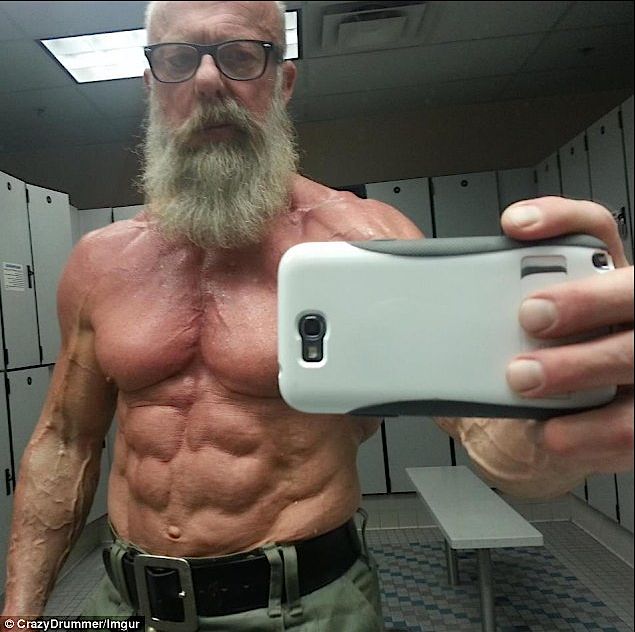
Pete Sisco — developer of Static Contraction Training and author of six McGraw Hill fitness titles — designed a study with a specific goal: to discover how much mass and size people could gain through brief, infrequent workouts. He did not use young college students with optimal recovery capacity. He deliberately selected the most challenging demographic available.
The participants were experienced trainees — not raw beginners — whose median age was 50 years old. This was a purposeful choice. If the results held at this age and experience level, they would hold anywhere.
Experienced trainees. Median age 50. Brief and infrequent.
- Each participant performed the same exercises, executed in exactly the same way — one set per exercise, six exercises per workout
- Participants were divided into three groups performing timed sets of 30, 60, and 90 seconds respectively
- Each group completed a minimum of eight workouts over approximately 60 days
- All participants were experienced trainees — not beginners — with a median age of 50
Several pounds of muscle and several inches gained on combined chest and arms — from just 8 workouts.
All three groups produced significant strength, mass, and size increases. One group stood out considerably from the others — gaining several pounds of muscle and several combined inches on chest and arms from eight workouts across 60 days. These were not beginners experiencing the rapid initial gains that newcomers to training often see. These were experienced trainees in their fifties, making gains that many younger trainees training more frequently would be pleased to achieve in a year.
The results confirm what the best abbreviated training practitioners have always argued — brief, infrequent, high-intensity training is not a compromise for older trainees. It is the most effective approach available to them.
Brief, infrequent sessions built around compound movements with adequate recovery between each one — the framework Sisco's study validated is the framework the Minimum Effective Strength System provides for exactly this demographic.
People are living longer —
and strength training determines how well.
The Sisco study results become more significant in the context of longevity research. Professor Majid Ezzati of Imperial College London, publishing in The Lancet, documented a dramatic forecast for life expectancy over the coming decades.
- Current average life expectancy — men (UK) 79.5 years
- Current average life expectancy — women (UK) 83.3 years
- Projected life expectancy by 2030 — men 85.7 years
- Projected life expectancy by 2030 — women 87.6 years
- Current UK population aged over 65 ~10 million
These projections matter in a specific way for the trainee over 50. The question is not only whether you will live longer — the research suggests you will. The question is whether those additional years will be spent with the physical capacity to do what you want, or whether declining muscle mass, bone density, and cardiovascular function will narrow that capacity year by year.
The research on strength training over 50 is unambiguous: consistent progressive resistance training slows muscle loss, increases bone density, maintains cardiovascular health, and preserves the physical independence that makes additional years genuinely worth having. The Sisco study adds to this the evidence that the gains continue to be available — not just the maintenance.
You can become fitter and stronger
than ever before — and you can start today.
The combination of Sisco's study results and Ezzati's longevity data produces a straightforward conclusion. People over 50 are going to live longer than any previous generation. The quality of that extended life depends substantially on whether they maintain and build physical strength during those years. The evidence shows they can — more effectively, with less time invested, than conventional training approaches suggest.
Brief, infrequent, high-intensity training is not a concession to age. It is the approach that the evidence consistently supports — for trainees of 25, of 50, and of 70 alike.
Building muscle and strength after 50 — consistently, sustainably, without the recovery cost that conventional programmes impose — is precisely what the Minimum Effective Strength System is built for. The Sisco study results confirm what the system's principles predict.