Danny Padilla
the Giant Killer —
Goliath-Slaying
Workout
Five feet two inches. Mr America and Mr Universe in the same year. The double progression method that made it possible.
The British Isles have a long tradition of giant killers — folk heroes who overcome impossible odds through courage and resourcefulness rather than size. Jack and the Beanstalk, David and Goliath, Jack the Giant Killer of Cornwall. The stories endure because the underdog victory never grows old.
In the 1970s, bodybuilding had its own giant killer. He stood five feet two inches tall and competed against men who towered over him. He won anyway.
Jack, Cormoran, and the pit —
how the giant killer earns his name.
Land's End, Cornwall — in the reign of King Arthur.
Near the Land's End of England, a farmer had an only son called Jack — bright, resourceful, and unafraid of anything. In those days, the Mount of Cornwall was kept by a fierce giant named Cormoran. Eighteen feet tall and three yards about the waist, he was the terror of all the neighbouring villages. He lived in a cave in the midst of the Mount, wading over to the mainland to seize livestock and ravage the countryside. For many years he had done this, and all Cornwall was in despair.
One day Jack happened to be at the town hall when the magistrates sat in council about the giant. He asked what reward would be given to the man who killed Cormoran. The treasure of the giant, they told him. Jack replied simply: "Then let me undertake it."
That night, Jack dug a pit outside the Mount, covered it with sticks and straw, and settled on the opposite side to wait. At daybreak he blew his horn. The noise brought the giant rushing from his cave — "You shall pay for this, I will broil you for breakfast!" — and no sooner had he uttered the threat than Cormoran tumbled headlong into the pit. Jack gave him a weighty knock to the crown with his pickaxe. The giant was killed stone-dead. Jack had his treasure, and Cornwall had its peace.
The giant killer of legend does not win through superior size. He wins through intelligence, patience, and the precision to strike exactly once — and strike hard.
Danny Padilla — one of the greatest
short muscle men in history.
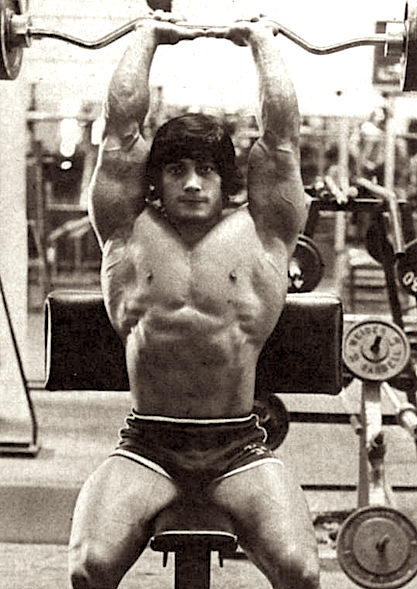
In the 1970s bodybuilding landscape — dominated by men of six feet and above — Danny Padilla was an anomaly. At five feet two inches, he had no business competing against the giants of the golden era. He competed anyway, and he won.
What Padilla brought to the stage was not size. It was symmetry — a level of proportional development so precise and complete that it rendered the height disadvantage irrelevant under competition conditions. Judges score proportion, muscle density, and aesthetic balance. At all three, Padilla was exceptional.
The credentials of a true giant killer.
- Mr Rochester — won at 17 years old. His hometown competition, his first major win.
- Mr USA — 1975
- Mr America — 1977
- Mr Universe — 1977
- One of only two men in history to win both Mr America and Mr Universe in the same year — the other being Frank Zane.
- Regular top-six finisher at the Mr Olympia throughout the late 1970s and early 1980s, competing against the greatest physiques of the golden era.
Danny Padilla trained simply. He used stripped-back basic concepts for lean mass gains and did not change his training much at all — preferring to stick with what worked. The method he used to build that extraordinary physique was the double progression.
Stripped-back training built on basic compound movements and a simple, consistent progression method — this is the same philosophy behind the Minimum Effective Strength System. Padilla's giant-killing was not complicated. Neither is the approach that works.
The double progression method —
simple, challenging, and it works.
The double progression method is one of the most straightforward and most effective progressive loading systems available. It requires no periodisation complexity, no percentage calculations, and no specialist knowledge — just the discipline to apply it consistently and the patience to earn each weight increase before taking it.
Same weight across all sets. Earn every rep. Add weight only when all sets are complete.
Padilla's standard approach used 5 sets of 12 repetitions, with the same weight across every set. The first two sets function as an extended warm-up — the weight is manageable and the movement pattern is grooved. By sets three, four, and five, fatigue begins to accumulate and the work becomes genuinely challenging. The final set is the test.
The progression rule is straightforward: when you can complete all 12 repetitions on all 5 sets with good form, you add weight at the next session. Not before. The rep target on every set must be reached — if the final set produces only 10 or 11 repetitions, the weight stays the same until all 5 sets of 12 are achieved cleanly.
This is the double in double progression — you progress in repetitions first, then in load. The rep range is the first gate. Only when it is cleared does the load increase.
The secret to success is that you never add weight until you earn it on that final set. This simple rule prevents the premature loading that produces stalled progress and poor form — and keeps the adaptation mechanism firing consistently over months and years.
The method works across multiple rep ranges. Choose the format that suits your goal.
- Padilla's standard — mass and symmetry 5 × 12
- Vince Gironda — density and conditioning 8 × 8
- Strength foundation — compound movements 5 × 5
- Gironda power variation 6 × 6
- Abbreviated single set — high intensity 1 × 8–12
Each format applies the same double progression logic — achieve the target rep count on every set before increasing the load. The format changes. The principle does not. Applied to compound movements — the squat, the deadlift, the press, the row — the double progression produces consistent, measurable strength gains that accumulate over months into the kind of development Danny Padilla built his giant-killing career on.
For the broader context of progressive loading principles and what strength targets actually predict in terms of muscular development, see the strength standards page.
Simple. Consistent. Progressive. Danny Padilla did not need complexity to build one of the most celebrated physiques of the golden era. Neither do you. The Minimum Effective Strength System applies the same stripped-back progression logic within a complete compound training framework.