Does Muscle
Burn Fat?
The 1970s Colorado Experiment — and what it revealed about simultaneous fat loss and muscle gain
The conventional wisdom on fat loss points toward cardio — the treadmill, the bike, the aerobics class. The evidence points elsewhere. Muscle tissue is metabolically active. Every pound of muscle your body carries burns calories continuously, at rest, twenty-four hours a day.
But the question goes further than that. Can the body actually convert existing body fat into muscle? A remarkable 1970s experiment provided the answer.
Why muscle is the body's
most effective fat-burning tool.
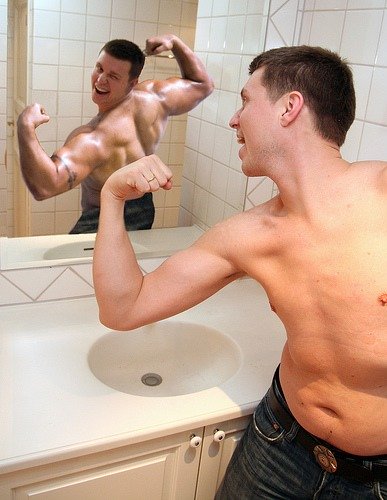
Unlike body fat, which is essentially inert storage, muscle tissue is metabolically active. It demands nutrients and calories for its growth, repair, and ongoing maintenance — and it makes those demands continuously, not only during exercise.
The metabolic difference — and why it matters long-term.
Aerobic exercise burns calories during the session. Strength training builds muscle that burns calories permanently — at rest, during sleep, and throughout every hour of the day. A trainee who adds five pounds of muscle to their frame raises their resting metabolic rate continuously. A trainee who runs five miles burns calories only while running. The compounding metabolic effect of building muscle makes weight training the superior long-term fat loss strategy — not as a replacement for cardio, but as the foundation that makes everything else more effective.
The best exercise to burn fat is not found on the treadmill. It is found in the weight room — because muscle tissue, once built, burns fat continuously rather than only during the session.
The compound movements at the centre of the Minimum Effective Strength System — squats and deadlifts in particular — work the largest muscle groups in the body, producing the greatest metabolic demand and the most significant fat-burning effect of any exercise combination available.
Three subjects. Three sets of results.
One conclusion.
In the 1970s, Nautilus inventor Arthur Jones conducted what became one of the most cited body composition experiments in strength training history. The Colorado Experiment, run over one month, produced findings that challenged established assumptions about the relationship between muscle gain, fat loss, and caloric intake.
62 lbs of muscle gained. 17 lbs came from converted body fat.
Viator consumed only enough calories to account for 45 pounds of gain. He added 62 pounds. The additional 17 pounds of lean mass was accounted for by body fat converted to muscle during the experiment — a result Jones described as the body literally stealing calories from stored fat to build muscle tissue. The finding remains one of the most striking body recomposition results ever documented.
20 lbs of muscle gained. Body fat dropped from 6.3% to 4.46%.
Jones himself was monitored alongside Viator — training with the same abbreviated high-intensity principles but without Viator's exceptional genetic capacity for muscle building. His results were independently impressive: 20 pounds of muscle gained while simultaneously reducing body fat from 6.3% to 4.46%. This confirmed that the fat-burning mechanism was not exclusive to elite genetic responders.
Sprint and high jump records broken. Fat shed. Muscle gained.
During the experiment, members of the Denver Broncos professional football team visited the lab to observe the workouts. Excited by the results, the Broncos ordered Nautilus equipment and adopted the same abbreviated, high-intensity training approach. Team members began gaining muscle and shedding fat in quick order — and proceeded to break their own sprint and high jump records as a consequence of the strength and body composition improvements.
The best exercise to burn fat —
and build muscle simultaneously.
The Colorado Experiment demonstrates that simultaneous fat loss and muscle gain is not only possible — it is the natural result of correctly applied high-intensity abbreviated strength training. The body, given the right stimulus, will draw on stored fat to fuel muscle building when caloric intake alone is insufficient.
The practical application is straightforward. Train the largest muscle groups with compound movements — the barbell squat and the deadlift — trained intensely and in an abbreviated fashion. These two movements, applied with genuine effort and adequate recovery, produce the metabolic demand that makes simultaneous fat loss and muscle gain possible. To attempt to build muscle and lose fat without them is to work significantly harder for significantly less.
The question is not whether muscle burns fat. It does — continuously, at rest, and in greater quantity with every pound of muscle added. The question is which training approach builds the most muscle most efficiently. The evidence is consistent on this point too.
Compound movements, applied with the minimum effective stimulus and adequate recovery — this is the approach that produces the simultaneous fat loss and muscle gain the Colorado Experiment demonstrated. The Minimum Effective Strength System applies these principles within a complete, structured framework.