How Do I Build
Muscle Without
Destroying My
Joints?
The goal is not building muscle for a few summers — it is building a body that still functions well decades from now
One of the great ironies of modern fitness culture is that many people begin training to improve their health — only to end up physically beaten down by the process. Walk into almost any commercial gym and you will see it everywhere: aching shoulders wrapped in supports, lifters limping between sets, inflamed elbows, stiff lower backs, and knees that sound like gravel being crushed every time someone squats. Yet much of the fitness world treats this as perfectly normal. Pain becomes a badge of honour. Joint damage becomes proof of commitment. Endless punishment is glorified as hardcore training.
The body keeps score. And while muscle can be rebuilt surprisingly quickly, damaged connective tissue often recovers painfully slowly. This becomes especially important after fifty — because the goal is not simply building muscle for a few summers. The goal should be building a strong, capable body that still functions well decades from now.
The body does not care about impressing other gym members —
muscles respond to tension, not ego loading.
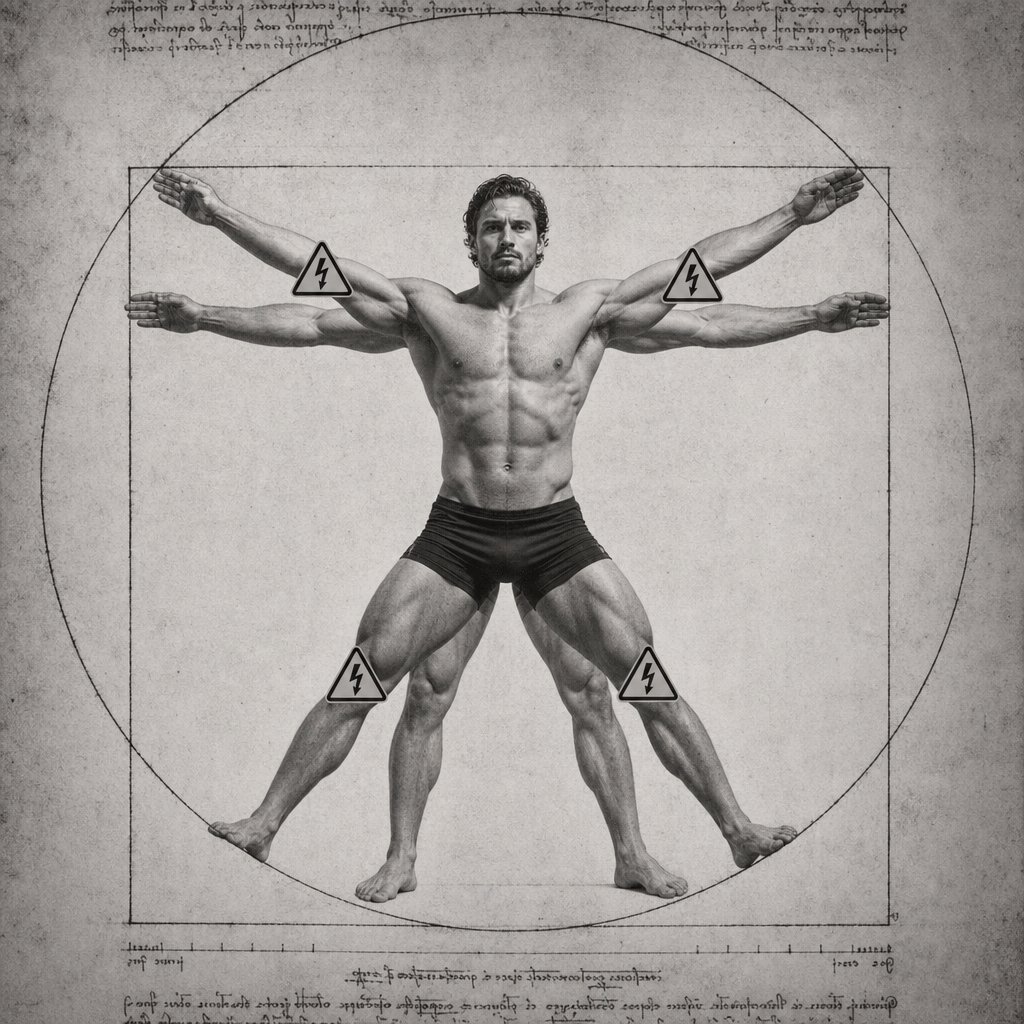
One of the biggest mistakes lifters make is confusing muscular stimulation with ego lifting. Many people assume heavier weight automatically equals superior muscle growth. In reality, the body does not care about impressing other gym members. Muscles respond primarily to tension, effort, progressive overload, and recovery. That distinction matters enormously — because once the goal shifts from moving weight to stimulating muscle, training often becomes dramatically safer and more effective simultaneously.
Many joint problems originate from sloppy technique, excessive momentum, shortened ranges of motion, uncontrolled repetitions, and constant maximal loading. The connective tissues absorb enormous stress while the targeted muscles often receive surprisingly poor stimulation. This is particularly common in ego-driven lifting environments where performance numbers become more important than movement quality.
A controlled dumbbell press performed with proper tension and technique frequently stimulates the chest more effectively than a reckless barbell press performed purely to move the heaviest possible weight. The same principle applies across nearly every exercise. Good training should challenge muscles aggressively while respecting joints intelligently.
Good training should challenge muscles aggressively while respecting joints intelligently. These two objectives are not in conflict — they are the same objective stated from different perspectives.
Tension over ego loading. Controlled execution. Progressive overload without reckless maximal grinding. These are the principles the Minimum Effective Strength System is built around — muscular stimulus delivered intelligently enough that the joints remain healthy through years of consistent training.
The body adapts beautifully to recoverable stress —
it breaks down under constant unrecoverable stress.
One of the harsh realities of ageing is that recovery resources become increasingly valuable. The body can absolutely continue building muscle after fifty — that is not the issue. The issue is recovering from excessive training stress. As people age, connective tissue recovery slows, inflammation lingers longer, sleep quality often declines, and nervous system fatigue accumulates more easily.
This means training methods tolerated reasonably well at twenty-five may become deeply problematic at fifty-five. Unfortunately, many mature trainees continue using programmes designed for genetically gifted twenty-year-olds with extraordinary recovery capacity. The result is predictable: chronic aches, stalled progress, persistent fatigue, and mounting frustration. Many people assume ageing itself is the problem. Often, the real problem is excessive workload combined with inadequate recovery.
The body adapts beautifully to recoverable stress. It breaks down under constant unrecoverable stress. This is why intelligent recovery management becomes one of the most important skills mature lifters can develop — not as a concession to age, but as the strategic understanding that separates consistent long-term progress from cycles of injury and frustration.
Movements that work with the body rather than against it —
effective stimulus without unnecessary structural stress.
One of the best ways to preserve joint health while building muscle is selecting exercises that work with the body rather than against it. Some movements consistently provide excellent muscular stimulus with relatively lower joint stress — and these are the movements that form the foundation of intelligent mature training.
None of these look particularly flashy on social media. All of them work — and continue working long term.
Centred loading reduces spinal strain while training legs, glutes, hips, and posterior chain effectively. Often dramatically more comfortable than barbell deadlifts for mature trainees.
Shoulders and wrists move naturally rather than being constrained to a rigid barbell path — often eliminating the joint irritation that barbell pressing accumulates over years.
One of the finest upper-body exercises available — back thickness, arm development, grip strength, and posture all trained through a natural pulling arc.
Particularly valuable for shoulder health, warm-ups, and controlled accessory work. Variable resistance is often kinder to ageing connective tissue than constant fixed loading.
Develop total-body stability and functional strength while placing relatively little repetitive stress on joints — and build the grip strength that research associates with healthy ageing.
Improves circulation, recovery, cardiovascular health, mobility, and body composition without creating enormous recovery debt. The most underrated exercise available to the over-50 trainee.
Connective tissue recovers far more slowly than muscle —
and excessive volume accumulates consequences quietly.
One of the biggest joint destroyers in modern fitness is excessive volume. Many people dramatically underestimate how much repetitive stress accumulates across endless sets, marathon workouts, redundant exercises, and constant high-frequency training. Connective tissue generally recovers far more slowly than muscle tissue — meaning a lifter may feel muscularly capable of more work while joints and tendons quietly fall further behind in recovery.
Shorter focused workouts that deliver strong stimulus without accumulating the repetitive wear that marathon sessions create.
- Effort — genuine focused muscular exertion on a small number of productive sets
- Efficiency — compound movements that train the most muscle per minute of joint stress incurred
- Recovery — sufficient rest for connective tissue to fully repair between sessions
- Progression — adding weight or repetitions consistently over time rather than adding volume
Ironically, many people build better physiques once they stop trying to annihilate themselves every session. Because the body grows during recovery — not during endless punishment. And the body's joints appreciate the difference even more than its muscles do.
"No pain, no gain" —
one of the most destructive ideas in the history of strength training.
Modern fitness culture often glorifies extreme suffering. "No pain, no gain" remains one of the most destructive ideas ever introduced into strength training. Of course, building muscle requires effort — hard training matters enormously. But productive effort and reckless destruction are not the same thing. The body responds to intelligent challenge. It breaks down under constant punishment.
Missing months or years due to preventable injuries destroys far more progress than training slightly more conservatively ever will. This is where patience becomes one of the most powerful qualities a mature lifter can develop. Muscle growth is rarely about finding the most extreme programme imaginable. It is about finding an intelligent approach you can sustain repeatedly for years.
Characteristics shared by the trainees who continue building strength long after others have quit.
Show up regularly for years rather than occasionally performing heroically — the compounding advantage that outlasts dramatic short-term effort every time.
Treat sleep, nutrition, and recovery management as seriously as the training itself — because that is where the adaptation actually occurs.
Prioritise technique and controlled execution over ego loading — protecting the joints that training depends upon for the long term.
Understand that sustainable progress compounds over time — and that preventable injuries impose a recovery debt that no amount of subsequent training can fully repay.
Longevity as part of the strategy —
not an afterthought.
One of the most important mindset shifts mature trainees must make is redefining what successful training actually looks like. The goal is not simply lifting the heaviest possible weights for a short period of time. The goal is building a body that remains strong, mobile, capable, energetic, and resilient for decades. This changes how you approach everything — exercise selection becomes smarter, recovery becomes more important, ego lifting loses its appeal, and longevity becomes part of the strategy rather than an afterthought.
And ironically, this approach often produces better physiques anyway. A body free from chronic inflammation, constant pain, and accumulated fatigue usually looks far more athletic than one perpetually battered by reckless training. The external signs of chronic overtraining — persistent puffiness, joint swelling, postural deterioration, and the worn, fatigued look of a body in constant distress — are not badges of dedication. They are warning signs.
The best training programme is not the one that leaves you crippled after ten years. It is the one that allows you to continue building muscle, strength, mobility, and vitality for the rest of your life. Train hard — but train intelligently enough that your body still thanks you for it twenty years from now.
Tension over ego. Controlled execution. Abbreviated programming. Intelligent recovery. These four principles build muscle effectively while protecting the joints that training requires for the long term — and they are the foundation of the Minimum Effective Strength System.