Jack LaLanne
Swimming Alcatraz —
What the Fitness
Godfather Teaches Us
The lesson behind the swim was never about swimming — it was about what becomes possible when you fully engage with life
When most people hear the name Jack LaLanne, they think of fitness. They think of exercise, health clubs, juicers, television workouts, and a man whose enthusiasm for physical activity seemed almost superhuman. Yet reducing Jack LaLanne's legacy to fitness alone misses the bigger picture. The true lesson behind Jack LaLanne swimming from Alcatraz Island while handcuffed and towing a boat is not really about swimming at all. It is about passion, purpose, and the extraordinary things that become possible when you fully engage with life.
In a world where many people accept declining health as an inevitable part of ageing, LaLanne stood as a living contradiction. Long before fitness became fashionable, he championed strength training, daily exercise, proper nutrition, and personal responsibility. More importantly, he embodied these principles. He did not merely talk about fitness. He lived it every day — right up until his death at the age of 96.
Not publicity stunts — demonstrations of what
the human body achieves when consistently cared for across a lifetime.
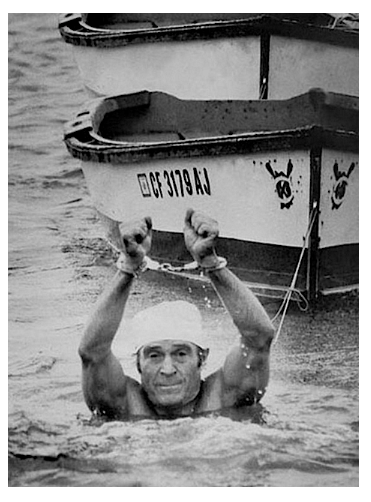
LaLanne's famous feats of endurance were never publicity stunts for their own sake. They were demonstrations of what the human body and mind could achieve when consistently cared for over a lifetime. His famous swims — performed shackled, handcuffed, or towing heavy loads — were not about physical extremism. They were about refusing to accept artificial limitations on what was possible.
Each achievement built on decades of consistent daily training — ordinary habits that accumulated into extraordinary capability.
A demonstration of the sustained physical capability his daily training maintained long after most people accepted decline as inevitable.
Swimming handcuffed from Alcatraz Island while towing a 1,000-pound boat through the cold waters of San Francisco Bay.
Handcuffed and shackled, towing 70 rowboats carrying 70 people — one boat for each year of his age — through strong winds and currents.
LaLanne maintained his two-hour daily training routine — ninety minutes of weightlifting and thirty minutes of swimming — until days before his death.
People saw the headline-grabbing achievements. What they did not always see were the decades of disciplined training that made those achievements possible. LaLanne did not become exceptional overnight. He became exceptional because he embraced exercise as a lifelong practice rather than a temporary project.
Daily practice. Consistent progressive training. Recovery taken seriously. These are the habits that built Jack LaLanne — and the same habits the Minimum Effective Strength System is designed to make sustainable for the natural trainee over fifty.
The happiest and longest-lived people
tend to remain engaged with life — not withdrawn from it.
One of the most overlooked aspects of health is the connection between physical vitality and happiness. We often think of happiness as something external — arriving through money, possessions, promotions, or circumstances. Yet when researchers study long-lived, fulfilled individuals, they frequently discover something much simpler. The happiest people tend to remain engaged with life. They maintain interests, pursue meaningful goals, stay physically active, and continue challenging themselves regardless of age.
Jack LaLanne understood this instinctively. Fitness was not merely a hobby for him — it was an expression of his enthusiasm for life itself. Every workout, every challenge, and every new goal gave him a reason to jump out of bed each morning with excitement. His physical training became a vehicle through which he expressed curiosity, purpose, and joy.
This is why passion matters so much. Passion gives structure to days and meaning to efforts. It provides momentum when motivation fades and creates a sense of progress even when life becomes difficult. The tragedy is that many people abandon their passions as they grow older — they begin to believe excitement belongs to younger generations, stop challenging themselves, and gradually retreat into increasingly sedentary lifestyles. LaLanne's example points firmly in the opposite direction. Passion does not have an expiration date. If anything, it becomes more important as we age.
Passion does not have an expiration date. LaLanne demonstrated this every day for nine decades — and his example remains one of the most compelling arguments for staying engaged with life rather than gradually withdrawing from it.
Movement as medicine — the body responds
continuously to the signals we provide it.
If there was one principle that defined Jack LaLanne's philosophy, it was that movement is medicine. While nutrition, mindset, relationships, and purpose all play vital roles in health, exercise forms the foundation upon which many of these other benefits are built.
The body responds to the signals we send — and regular exercise sends the most powerful signal available.
Dr Henry Lodge explored this concept in Younger Next Year — arguing that ageing is not simply a passive process that happens to us. The body responds continuously to the signals we provide. When we stop moving, those signals encourage decline. Muscles weaken, cardiovascular fitness deteriorates, metabolic health worsens, and the body gradually shifts into preservation mode. Conversely, regular exercise sends a powerful counteracting message — that strength is still required, that muscle tissue should be maintained, that life is still being lived actively. LaLanne grasped this truth decades before modern research confirmed it. He recognised that exercise was not punishment or a chore to endure. It was an investment in vitality.
This is why so many people experience dramatic improvements in energy, mood, sleep quality, and overall wellbeing when they commit to regular physical activity. The benefits extend far beyond appearance. Exercise changes how you feel, how you think, and ultimately how you experience daily life.
Not merely about appearance —
about maintaining the ability to live fully for decades to come.
Although Jack LaLanne became famous for extraordinary endurance feats, he was also a passionate advocate of resistance training throughout his entire life. This remains one of the most valuable lessons mature trainees can take from his example.
Many people assume strength training is primarily for athletes, bodybuilders, or younger individuals seeking bigger muscles. In reality, resistance training becomes increasingly important as we age. After thirty, muscle mass naturally begins to decline unless deliberate action is taken to preserve it. Left unchecked, this loss accelerates over time — contributing to weakness, reduced mobility, poorer balance, and a diminished quality of life.
Strength training helps reverse this process. It preserves muscle tissue, strengthens bones, improves joint stability, enhances metabolic health, and supports independence later in life. For mature trainees, building strength is not merely about aesthetics. It is about maintaining the ability to live fully and confidently for decades to come. A few well-chosen compound exercises performed consistently can produce remarkable improvements without requiring endless hours in the gym — because the goal is not to train constantly but to stimulate adaptation and allow recovery to complete.
Extraordinary results are built on ordinary habits
performed consistently over many years.
The most valuable lesson from Jack LaLanne's famous Alcatraz swim is not that you should attempt to tow a thousand-pound boat through cold water. It is that extraordinary results are often built upon ordinary habits performed consistently over many years. The same principle applies to every reader of this site.
None of these make headlines. Together they transform health just as surely as they transformed Jack LaLanne's.
- A daily walk — movement integrated into everyday life rather than reserved for occasional heroic efforts
- A sensible strength training programme — performed consistently for years, not pursued recklessly for months
- Nutritious whole food — LaLanne's dietary discipline was as consistent as his training discipline
- Adequate recovery — two hours of daily training balanced by genuine respect for sleep and recuperation
- Staying engaged with life — pursuing passions, maintaining curiosity, and refusing to accept decline as inevitable
Jack LaLanne's remarkable life reminds us that ageing does not have to mean surrender. It does not require accepting weakness, inactivity, or declining enthusiasm for life. Through his example, he showed that physical fitness is about far more than muscles or appearance. It is about cultivating the energy, strength, and vitality needed to pursue the things that matter most.
You may never swim from Alcatraz while towing a boat. But you can adopt the mindset that made Jack LaLanne one of the most vibrant and inspiring figures in fitness history — commit to daily movement, build strength patiently, stay curious, stay engaged, and find something worth being passionate about. That may be the greatest fitness lesson of all.
Daily training. Intelligent recovery. Consistent progression. A refusal to accept decline as inevitable. The LaLanne philosophy applied to the natural trainee over fifty — and the foundation the Minimum Effective Strength System is built upon.