Landmine Complexes —
Explosive Muscle Mass
and Fat Loss
Dan John's training density principle — why not putting the bar down changes everything
Most people believe building muscle and losing fat simultaneously is not possible. The evidence from barbell complexes — and their landmine variation — suggests otherwise. The mechanism is training density, and it is both simple to understand and demanding to apply.
Strength coach Dan John has made complexes the cornerstone of his conditioning and mass-building work for decades. Here is why.
The day a single rule changed
everything about the workout.
Dan John's introduction to complexes came at Southwood Junior High in San Francisco, where his weight training programme at the time consisted of a straightforward combination of cleans, presses, and squats.
One day, his instructor Mr Freeman made a single modification to the session. The exercises were identical — cleans, presses, and squats — but one rule was added: once you picked the bar up, you were not allowed to put it down until all three movements were complete.
"I choked on those last reps of the front squat trying to figure out where I left my lungs."
Dan JohnThat experience stayed with John. Decades later, the proof of complexes' effectiveness arrived from an unexpected direction. A student approached him during a session transition with a request: could he have a copy of all the complex workouts for his father? The rest of the firefighters at the fire department wanted to use them. When John asked why, the answer was straightforward — everybody was getting results.
This is why Dan John makes complexes the cornerstone of his conditioning and mass-building programmes. The method is unglamorous and brutally effective in equal measure.
Complexes and the Minimum Effective Strength System share the compound movement foundation — but serve different goals. M.E.S. is built for consistent, sustainable strength progress with minimum recovery cost. Complexes are built for simultaneous fat loss and conditioning alongside muscle maintenance. They are complementary tools, not competing ones.
Training density — the mechanism
behind simultaneous muscle gain and fat loss.
The effectiveness of complexes rests on two specific training variables that are directly manipulated by the no-put-down rule. Understanding these variables explains both why complexes work and why the landmine variation amplifies their effect further.
More work. Longer load. The same session duration.
- More work completed in less time By removing rest between exercises, total volume — weight lifted multiplied by repetitions — increases significantly within the same session duration. The body must process a greater training demand without additional recovery time. This metabolic overload is what triggers simultaneous fat burning and muscle building.
- Extended time under tension Sequencing exercises without rest keeps the muscles under continuous load for longer. Time under tension is a primary driver of muscle hypertrophy — and complexes exploit it directly through their no-rest structure rather than through additional sets or exercises.
These two mechanisms together produce what coaches call training density — more work in less time, with the muscles under load for longer. The cardiovascular demand from continuous movement combines with the muscular stimulus from the compound exercises to produce the result the firefighters discovered: body composition improving in both directions simultaneously.
Dan John's six-exercise complex —
begin light and earn the weight.
The rule for all complexes is the same: the bar does not touch the ground until the final repetition of the final exercise in the circuit is complete. Begin with just the training bar — no additional weight — until the movement patterns are fully established and the cardiovascular demand is well understood. Add weight only when the current load feels genuinely manageable throughout the full circuit.
Bar stays up. All six movements. Then rest.
- Barbell row — 5 repetitions
- Hang clean — 5 repetitions
- Front squat — 5 repetitions
- Military press — 5 repetitions
- Back squat — 5 repetitions
- Good mornings — 5 repetitions
Why the landmine amplifies
everything complexes already do.
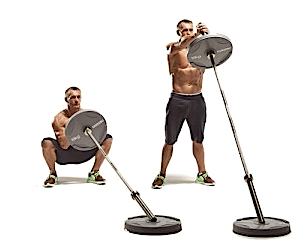
The landmine is a simple piece of equipment — a sleeve that anchors one end of a barbell to the floor, allowing the free end to be pressed, pulled, and rotated through a range of movements that a standard barbell cannot replicate. If your gym does not have a dedicated landmine attachment, propping a barbell in a corner achieves the same effect.
California personal trainer Ben Bruno has made landmine complexes a specific area of focus and articulates their advantages precisely.
Three specific benefits the standard barbell complex does not provide.
- Cross-body loading fires up the core and glutes more aggressively than bilateral barbell work — the rotational demand adds a stabilisation requirement throughout every movement
- A significant training effect is achievable with less overall load than with a standard barbell, making the landmine safer for the joints while preserving the full muscular stimulus
- Holding the thick sleeve of the barbell taxes the grip and works the forearms as an additional training stimulus throughout the complex
The joint-friendly benefit is particularly relevant for trainees with shoulder or wrist concerns. The arc of movement the landmine creates is more natural than the fixed vertical path of a standard overhead press — making pressing movements accessible to a broader range of trainees without reducing the upper body stimulus.
Complexes and landmine training are tools for specific goals — conditioning, fat loss, and time-efficient training density. For a complete strength framework built on the compound movements that underpin them, see the Minimum Effective Strength System.