Burke's Law of
Bodybuilding —
More from Five
Hours Than Six
Days a Week
How champion bodybuilder Paul Burke defeated MS and a ruptured spinal nerve — and found a better way to train in the process
Sometimes the most compelling arguments for training intelligently come not from research papers or elite coaches, but from individuals who had no choice but to find a better way. Paul Burke is one of those individuals. A champion bodybuilder forced by catastrophic illness to abandon everything he thought he knew about training, he eventually emerged with something far more valuable than the approach he lost — a programme that delivered superior results from a fraction of the effort.
His story is one of the most powerful real-world demonstrations of the abbreviated training principle on record. And his conclusion — that five hours a week of focused intelligent training now outperforms twice-daily six-day competition-era sessions — is not the consolation prize of a reduced schedule. It is the result of being forced to discover what actually matters.
From champion bodybuilder to MS diagnosis to
ruptured spinal nerve — and back.
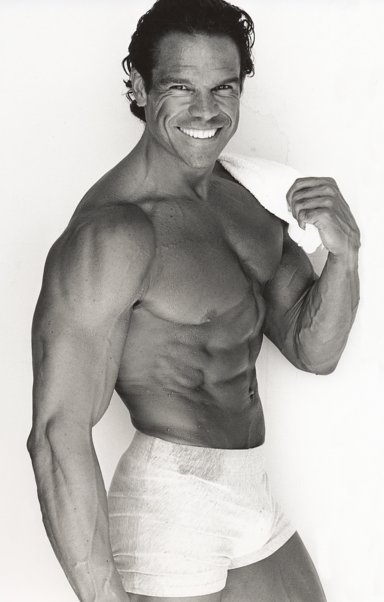
In 1995, Paul Burke was diagnosed with Multiple Sclerosis. For many people, this diagnosis would have ended any serious athletic ambition. Burke refused that conclusion. He researched the condition thoroughly, treating himself with a combination of nutrition and a gradual, carefully managed build-up of exercise. Through discipline and determination, he put the MS into remission.
What followed was, if anything, crueller. While training at a point when he was in the best shape of his life, Burke ruptured his spinal accessory nerve. The injury was so severe that at least two physicians believed he would not survive. He lost function throughout the entire right side of his body and endured four years of excruciating pain. During this period the MS returned. He required a sling to support his arm and shoulder as his damaged muscles could no longer hold their position independently, and relied on prescription painkillers simply to manage daily life.
Every setback eventually redirected him toward a more intelligent approach than the one he had practised before.
- Early 1980s — Competing as a champion bodybuilder, training twice a day, six days a week
- 1995 — Multiple Sclerosis diagnosis. Self-managed through nutrition and gradual exercise. Achieves remission.
- Post-remission — Returns to training. Reaches the best condition of his life.
- Following year — Ruptures the spinal accessory nerve while lifting. At least two doctors predict he will not survive.
- Four years — Complete loss of right-side function. Excruciating pain. MS returns. Sling, painkillers, uncertainty.
- Recovery — Gradual return to movement, nutrition management, and an entirely reimagined training approach.
- Present — Actor, author, monthly fitness columnist answering questions from over-40 trainees worldwide.
Burke's survival and recovery are remarkable enough on their own terms. What makes his story additionally valuable is what the forced rebuilding process taught him about training — lessons that apply to every natural trainee, not only those managing serious illness.
Burke's conclusion that abbreviated training outperforms marathon sessions is one that the Minimum Effective Strength System reaches from a different angle — not necessity, but principle. The minimum effective stimulus produces superior results because it respects recovery. Burke proved this through necessity. M.E.S. applies it by design.
Four sets per body part. A simple circuit.
Thirty minutes. Done.
Because of his MS, Burke's training approach is not merely a preference — it is a medical necessity. Multiple Sclerosis requires that he maintain continual motor function, and the training that supports this is specific. Marathon bodybuilding sessions are entirely excluded. In their place, Burke performs four sets per body part in a simple rotating circuit, following a warm-up, resting only long enough to repeat the entire cycle.
His programme is elegant in its simplicity. No supersets, no drop sets, no forced reps, no techniques designed to maximise muscular breakdown. A small number of carefully selected exercises, performed with genuine effort, in the most time-efficient format possible.
The weights are real. The reps are real. And the result outperforms twice-daily competition training.
250 lb — 20 reps. As heavy and as many as possible. The primary back movement.
60–80 lb dumbbells — 20 reps or more. Full range, controlled execution.
Strict bicep isolation — removing the momentum that ruins most curl variations.
20 reps. Completing the push-pull-arms circuit with full tricep extension.
"I will do low pulley rows as heavy and as many as I can (usually 250 lbs for 20 reps), then I do bench presses with 60-80 lb dumbbells for 20 reps or more, followed by preacher curls and then 20 reps of triceps pushdowns. I rest long enough to repeat the entire cycle. I am usually done in 30 minutes."
Paul Burke — Exercise for Men OnlyFive hours a week now. More results than
twice a day, six days a week then.
The most striking element of Burke's story is not his survival — impressive as that is. It is his direct comparison between his competition-era training and his current approach. This comparison challenges one of the most deeply held assumptions in mainstream fitness culture head-on.
Fewer sessions, less time, better results. The abbreviated training principle demonstrated by a champion who has experienced both approaches firsthand.
Twice a day, six days a week. The high-volume approach that defined competitive bodybuilding of the era — and the approach that most mainstream training culture still promotes.
Abbreviated circuit training, four sets per body part, thirty-minute sessions. Burke states explicitly that he gets more out of five total hours a week now than he did working out twice a day in competition.
Burke's conclusion is not the rationalisation of someone who can no longer train as hard as they once did. He is describing a genuine outcome comparison from someone who has experienced both approaches at serious levels. The abbreviated programme outperforms the marathon programme not because it is easier, but because it respects the recovery process that actually produces results. The effort within each session is real. The recovery between sessions is what makes it productive.
Adversity clarifies what is essential —
and what Burke discovered under the worst conditions applies universally.
Burke did not choose the abbreviated training approach because he read a convincing argument about recovery. He was forced into it by circumstances that left no other option. In the process, he discovered what remains hidden from most high-volume lifters who never face a compelling reason to question their approach — that more training is not always better training, and that the quality of the stimulus and the quality of the recovery determine results far more than the quantity of sets performed.
His story is also a powerful reminder about perspective. Training, for most people, is a privilege rather than a necessity. The ability to lift weights, to move freely, to recover between sessions and return stronger — none of these are guaranteed. Burke's four years of excruciating pain and lost physical function, followed by his patient and disciplined recovery, demonstrate both the fragility and the resilience of the human body under extraordinary pressure.
The lesson that Burke's experience offers every natural trainee is simple. Adversities in life need not define us. And when forced to strip training back to its most essential elements, we sometimes discover that those essential elements were all we ever needed.
"I get more out of five total hours a week now than I did working out twice a day, six days a week when I was competing in the early 1980s."
Paul Burke — Exercise for Men OnlyFour exercises. One circuit. Thirty minutes. More results than twice-daily competition training. Burke's law and the Minimum Effective Strength System reach the same conclusion from different directions — the minimum effective stimulus, applied with genuine effort and protected by adequate recovery, consistently outperforms excess.