Static Contraction Training
by Lee

Many trainees greatly underestimate the intensive burden static contraction training puts on their bodies. For example: leg pressing 1,000 pounds in a static hold is the equivalent to lifting an adult Jersey cow - that is a 1/2 ton of dairy cattle!
These kinds of heavy weights don't only stress the joints, muscles and connective tissues, but stress the entire central nervous system.
This should naturally lead us to ask, "How can you expect to build any muscle before you are fully recovered?" The simple answer is, you can't. Until a single ounce of muscle can be built, the body must first replenish itself. This takes time.
Balancing optimal training with optimal recovery is how you make strength and muscle gains. If you are lifting heavy weights to build muscle - and you MUST - there are no shortcuts.
Join in and write your own page! It's easy to do. How? Simply click here to return to Comments.

Recent Articles


-
Best Weight Training Exercises - Unlock the Secret of the 80 20 Rule
May 02, 26 11:47 AM
 The best weight training exercises and the 80/20 rule — why 20% of exercises produce 80% of results, the five compound movements that make that 20%, and how Paul Anderson built extraordinary strength…
 -
Danny Padilla the Giant Killer's Goliath-Slaying Workout
May 02, 26 04:25 AM
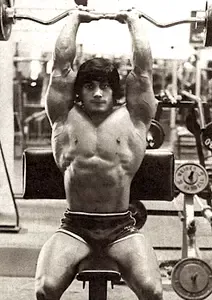 Danny Padilla the Giant Killer — Mr America and Mr Universe 1977, five feet two inches tall. How one of the golden era's greatest physiques was built on the double progression method explained.
 -
Exercise and Lifting Weights: The Tao of Training for Strength
May 01, 26 12:16 PM
 The Tao of Training — an ancient principle applied to lifting weights. Why doing less with precision beats doing more with complexity, and why the Tao approach becomes more valuable, not less, after 5…