The Iron Was Calling
From the Charles Atlas Advertisement to the Syosset Home Gym — The Moments That Started It All
Every lifter has a first moment. The thing that lit the fuse — a magazine, a film, an older sibling's weights left in a corner. For most of us, that moment arrives before we have any idea what it means, or where it will lead.
For Robert Sparkman, it was a comic-book advertisement. The year was 1967. Robert was ten years old. And a single image — the "97-pound weakling" being humiliated on a beach — struck him, in his own words, like a lightning bolt to the soul.
What follows is Robert's account of those earliest years: the Charles Atlas course devoured in a childhood bedroom, a twelve-year-old's savings lost to a failed barbell order, and the moment he finally wrapped his hands around a borrowed York barbell in a friend's Syosset basement and felt something click into place. It's a story about how the Iron Game finds you — often when you're far too young to understand what you've just agreed to.
I've read a great deal of Robert's writing now, and this piece feels different. This is where everything began. It makes everything that followed — the decades of training, the friendships forged through sweat, the archive he's building here — make complete sense.
The year was 1967. I was just a ten-year-old boy, my eyes glued to the pages of a comic book, when I saw an image that would fundamentally change the trajectory of my entire life. It was the iconic advertisement that launched a thousand dreams: "The Insult That Made a Man Out of Mac" — the 97-pound weakling getting sand kicked in the face by a beach bully.
To most people, it was simply clever advertising. To me, it was a revelation — a lightning bolt that struck my soul and ignited an insatiable, lifelong quest for strength. That single advertisement didn't just introduce me to Charles Atlas; it opened the gateway to a mystical and beautiful world I would come to know as physical culture.
I wasted no time ordering his famous Dynamic Tension mail-order course. When it finally arrived, I didn't just read it — I devoured it. I fell deeply in love with the daily ritual of movement. Every afternoon, I transformed my childhood bedroom into my own sanctuary of strength, following Atlas's teachings with the kind of wholehearted devotion only a ten-year-old boy can possess. I meticulously adopted his recommendations on exercise, nutrition, and hygiene, investing my young heart and soul in his philosophy.
One of my favorite and most enduring rituals was throwing my bedroom window wide open, no matter what the weather was doing outside. I wanted to breathe the healthy, life-giving, energizing fresh air that Atlas taught was so important for vibrant health. Breathing in that crisp air, I would pour every ounce of my enthusiasm, effort, and heart into my daily exercises.
Even then, as a little boy, I sensed that I was building something far greater than muscle. I was building a mindset. I was building discipline. I was beginning to build a life around the principles of physical culture — a fire that, all these decades later, still burns fiercely within me.
I didn't know it then, but two years later I would pick up a York barbell for the very first time.
And when I did, something inside me clicked.
The exercises in my bedroom had opened the door.
The iron was calling.
The $120 Lesson
How a Twelve-Year-Old's Lost Barbell Order Pointed Me Toward York
By the time I was twelve years old, the Iron Game had already gotten its hooks into me. I wanted barbells, plates, dumbbells — anything that would help me become stronger. But equipment cost money, and I understood that if I wanted it badly enough, I was going to have to earn it.
So I did. I shoveled snow. I raked leaves. I mowed lawns. I took whatever small jobs a twelve-year-old boy could find and slowly watched my savings grow. Eventually, I had accumulated $120 — a small fortune to me at the time, and every dollar represented work I had done with my own two hands.
Then came what felt like an enormous decision: York or Weider?
I studied my options carefully. York Barbell was in Pennsylvania. I also remember Weider equipment being available through distributors on opposite sides of the country — one in California and another in New Jersey. Living on Long Island, I did what seemed sensible. I compared costs, especially shipping, and the New Jersey option appeared to be the least expensive.
My father took the money I had worked so hard to save and wrote a check for the equipment order. In my young mind, the hardest part was over. I had earned the money, made my choice, and now all I had to do was wait for the boxes to arrive.
They never did.
As I remember it, the New Jersey operation went out of business and my money was gone. My father tried to get answers and eventually contacted the Weider organization in California. He was told that the New Jersey distributorship was not affiliated with them. Whatever the business circumstances may have been, none of those distinctions meant very much to a devastated twelve-year-old boy.
I had worked for that money. I had imagined opening those boxes, assembling the equipment, wrapping my hands around the bars, and beginning the next stage of my transformation. Instead, there was no equipment and no $120.
Dad was disappointed too. I remember him saying that even if nothing else could have been done, a complimentary one-year subscription to one of the magazines would at least have been a kind gesture. It would not have replaced the money, of course. But to a young boy who loved the Iron Game, it would have said something simple and meaningful: We see what happened. We are sorry. Keep training.
Nothing came.
For a while, I was crushed. But one of the gifts life has given me is the ability to search for a silver lining, even when I cannot see it immediately. Looking back now, I think I can see one here. That experience did not extinguish my love of strength training. If anything, it redirected it. From then on, my heart increasingly belonged to Bob Hoffman, York Barbell, Strength & Health, John Grimek, and the great tradition surrounding Muscletown, USA.
I do not need to turn a childhood disappointment into bitterness, and I certainly do not pretend that a twelve-year-old boy understood the business relationships involved. What I know is much simpler: I lost my money, I was deeply hurt, and then I kept moving forward.
The Iron Game remained.
And York became home.
Seven years later, at nineteen years old, I would climb into my green Skylark GS with $400 of hard-earned money burning a hole in my pocket and point the car toward York, Pennsylvania. This time, I intended to buy York Barbell equipment directly from the source.
As things turned out, I would come home without any new equipment that day, either.
But that's another story.
The Barbell That Started It All
A Syosset Iron Game Memory
When I wrapped my hands around the cold-rolled steel of that York Big 12 Special barbell during my very first workout, I was hooked. It happened late one afternoon during the summer of 1969, while I was lifting weights with my best friend, Lew, in the cluttered, musty basement of his Syosset home. The York barbell and dumbbell set we were using belonged to Lew's older brother, Richard.
Richard was several years older than Lew and me. He was lean and athletic and already had an interest in physical culture, fitness, health, and strength. At our age, that made an impression. Lew and I looked up to him. Long before I knew where my own journey with the Iron Game would lead, Richard was one of the first real-life examples I had of the kind of healthy, fit, strong person I hoped someday to become.
And there, in Richard's cluttered basement, sat the equipment that would quietly change the direction of my life. I couldn't possibly have known it then, but wrapping my hands around his old-school York barbell would become one of the defining moments of my life.
Home training equipment in those days was relatively simple. There were no elaborate machines, electronic displays, or sophisticated home-gym systems. What Richard had was basic iron — and it was more than enough. A barbell, dumbbells, plates, and a handful of accessories provided everything two eager young fellows needed to begin discovering what progressive resistance training could do.
And I loved it.
Lew and I continued training together for the next couple of months, but before long I desperately wanted a York set of my own.
I had seen the advertisements. Across the page, in bold lettering, were words almost impossible for a young aspiring lifter like me to resist:
YORK BIG 12 SPECIAL — CHOICE OF CHAMPIONS
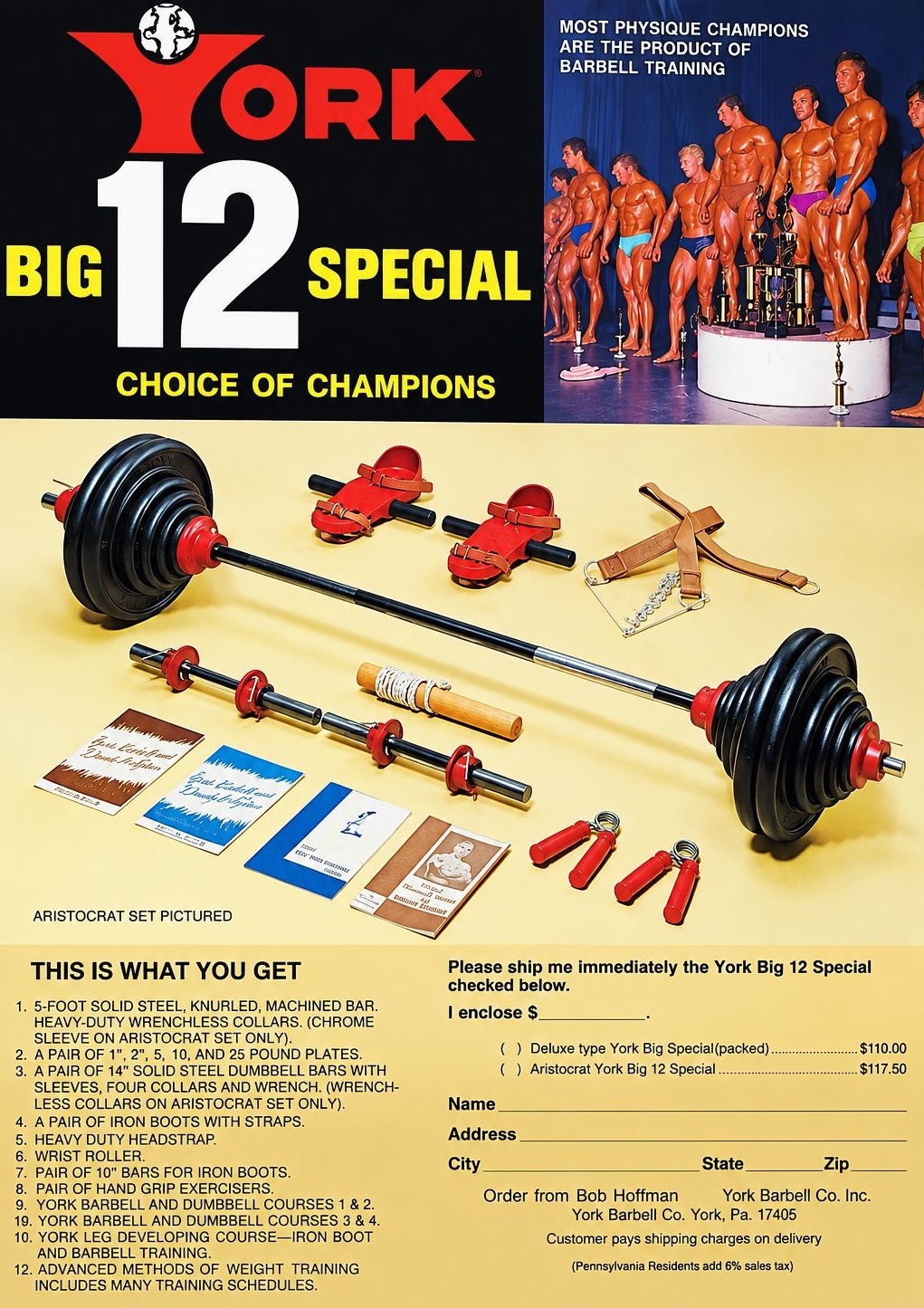
The set seemed phenomenal to me. A five-foot solid-steel knurled bar, plates, dumbbell bars, iron boots, a heavy-duty headstrap, wrist roller, hand-grip exercisers, and York training courses — it wasn't merely a collection of equipment.
To me, it was an invitation into the Iron Game.
My mom and dad knew how badly I wanted one. They also knew what had happened with Weider and the $120 I had worked so hard to save — money that disappeared when the New Jersey operation I had ordered from went out of business.
They felt terrible about what had happened.
So Mom and Dad did something I have never forgotten.
They treated me to my very own York barbell and dumbbell set.
To someone else, it might have looked like little more than a pile of iron packed into boxes.
To me, it was treasure. And with my very own York Big 12 Aristocrat barbell and dumbbell set finally in hand — and with my parents' blessing to allow Lew, our friends, and me to use their garage for a home gym — the next chapter of my Iron Game journey was about to begin.
More than half a century later, my hands still find their way back to the bar.
Syosset Home Gym
Now, finally having my very own York Big 12 Aristocrat barbell and dumbbell set, and with my parents' blessing to allow me and my friends to use their garage for a home gym, the next chapter of my Iron Game journey was about to begin.
Our family car was an old, funky green Chevy station wagon. Even though she wasn't particularly pleasant to look at, she was dependable. My parents hadn't parked the green beast in the one-car garage for some time, and over the years the dank, dark, and dingy space had accumulated what seemed like a lifetime's worth of unnecessary clutter. My best friends and I went to work, disposing of what seemed like an endless collection of nonessentials. When we were finally finished, we had a much smaller workout area than we would have liked, but it didn't matter. It was now going to be our very own dedicated training space.
We were beyond thrilled.
We had officially become the very first bona fide garage gladiators in the neighborhood.
We trained in the afternoons after school and occasionally on weekends. At the time, the only equipment we had was my York barbell and dumbbell set, so our makeshift, Spartan setup allowed us to concentrate on the basics: presses, curls, barbell and dumbbell rows, and upright rows. We would rotate through the exercises, taking turns between the four of us. For our chests, we relied on the most basic exercise of all — push-ups.
I was the only one performing both squats and stiff-legged deadlifts because they were brutally hard when pushed to your limits. Besides, I didn't have a squat rack or power rack back then. To perform my squats, I had to clean the barbell to my shoulders, press it overhead, and then lower it behind my neck onto my traps. That process alone was a workout. When I finished my squats, I had to reverse the process to get the barbell back to the floor.
There weren't any lights or windows in that garage. It wasn't heated during the winter, either. The wooden frame and studs were completely exposed, and the place was about as rustic as you could imagine. But we loved it. We embraced that old-school, no-frills atmosphere and turned that cold, dark space into our own little sanctuary.
During those cold and snowy Long Island winters, my mom and dad worried that we'd freeze our butts off when the weather became brutally frigid outside. They had good reason to worry. We were young, enthusiastic, and probably a little crazy, but nothing was going to keep us away from the iron.
After saving enough money over the next couple of years, I decided to purchase a couple of solidly built pieces of equipment from Ed Jubinville: a flat bench and a combination standard-weight-plate lat pulldown and low-row pulley machine. Both pieces were built like tanks. They were simple, rugged, functional, and exactly what a young lifter on a budget needed.
Ed Jubinville Weight Exercising Equipment had become a legendary mail-order source for strength-training equipment. Manufactured by bodybuilder and muscle-control expert Ed Jubinville in Holyoke, Massachusetts, the equipment was known among old-school lifters for its sturdy construction, practical designs, and affordable prices. Jubinville understood that young bodybuilders and strength enthusiasts didn't need fancy equipment — they needed equipment that worked, equipment that could take a beating, and equipment they could actually afford.
After our first winter in the garage, my parents generously allowed us to take over half of the basement for our two new pieces of equipment.
Our newfound training mecca was nothing fancy. In fact, our subterranean dungeon felt almost completely disconnected from the outside world. It had low ceilings, exposed pipes running overhead, and bare concrete floors. Space was tight, creating an intimate, intensely focused atmosphere. There was no room for vanity or distraction. We weren't there to admire ourselves in mirrors or worry about appearances. We were there to work.
We were there to battle the iron.
And we shared that space with a handful of other lifters who possessed the same singular obsession.
When our training sessions finally ended, we would emerge victorious, exhausted, and sweating profusely. Then came one of my favorite parts of the entire ritual: our post-workout pilgrimage to the local delicatessen, about a quarter of a mile from my house.
The endorphins had already kicked in. We felt alive, pumped up, and almost invincible — like we were on top of the world. We were teenagers who had just finished a hard workout with our best friends, walking down the street absolutely starving, feeling ten feet tall.
We had become kindred spirits — brothers-in-iron, bound together by the pursuit of building our bodies and testing what we were capable of accomplishing.
And then there was the food.
Our sumptuous post-workout feast consisted of one or two meat-and-cheese sandwiches on whole-wheat bread, piled to the hilt, a quart of whole milk, a tub of potato salad, and usually a piece of fruit. I always ordered two extra-thick sandwiches.
We bonded over Iron and Food!
For four best friends on a fitness quest together, it simply didn't get any better than that. We were inseparable.
Each of us began developing our own identity as a lifter. Jamie was known for being a push-up machine. It was a thing to behold watching him crank out massive numbers of high-repetition push-ups. Dave was the bench-press king. Lew was lean and fit, with an athletic build that reflected his dedication. And I became known for my squat and deadlift prowess.
Little by little, something began to change.
We didn't just say we were lifters anymore.
We looked like lifters.
We acted like lifters.
And, most importantly, we had earned it through countless hours of training, grit, determination, and a ton of sweat.
When I look back now, decades later, I realize that the equipment itself was only a small part of what made those places so special.
The garage and basement weren't beautiful. They weren't spacious. They weren't climate-controlled. We didn't have rows of machines, polished floors, elaborate lighting, or anything resembling the modern commercial gym.
What we had was something far more valuable.
We had each other.
We had youth, friendship, enthusiasm, determination, and an almost childlike excitement about discovering what our bodies could do. We had the iron, a place to train, and the freedom to pursue something we had fallen completely in love with.
I will forever treasure those memories — and, even more importantly, the bonds of friendship we forged through grit, determination, laughter, and a whole lot of sweat. With the passing of time and the decades fading away, we have all grown older, our lives have taken different paths, and that little garage and basement gym have long since become memories.
But the friendships remain.
We all still keep in touch after all these years.
And perhaps that's one of the greatest gifts the Iron Game ever gave us.
Once an Iron Warrior, always an Iron Warrior.
Steel is unbreakable.