Walking with
Weights — Why
Dan John Thinks
Carries Can
Change Your Life
The exercise that looks the simplest often produces the most profound results — and no one makes that case more convincingly than Dan John
The year is 1992, and a song called Walking in Memphis is climbing the charts around the world. Written and performed by singer-songwriter Marc Cohn, the song recounts a life-changing trip to Tennessee — a hauntingly beautiful track that would win a Grammy Award and become one of the defining songs of the decade. At first glance, a chart-topping ballad might seem to have absolutely nothing to do with strength training. Yet hidden inside the title is a clue that points toward one of the most underrated exercises ever created.
That clue is walking. Not strolling aimlessly through the park while scrolling through your phone. Walking with purpose. Walking under load. Walking while carrying weight. And once you understand why old-time strongmen, modern strength coaches, and elite athletes swear by this simple movement, you may never look at walking the same way again.
Unlike most gym exercises that isolate a single muscle group,
loaded carries demand total-body effort.
Anyone who has watched the World's Strongest Man competition will be familiar with the Farmer's Walk. Competitors pick up a pair of brutally heavy implements and walk as far and as fast as possible. No complicated techniques. No fancy equipment. Simply a test of strength, determination, and grit. Yet beneath that simplicity lies one of the most effective exercises ever devised.
Walking with weights forces your entire body to work as a coordinated unit. Your hands must grip the implements. Your shoulders must stabilise the load. Your abdominal muscles must brace to protect the spine. Your hips and legs must propel you forward. Even your feet are working overtime to maintain balance and stability. Unlike many gym exercises that isolate a single muscle group, loaded carries demand total-body effort. They teach the body to function as one integrated system — which is precisely why Farmer's Walks have remained a staple of strongman training for generations.
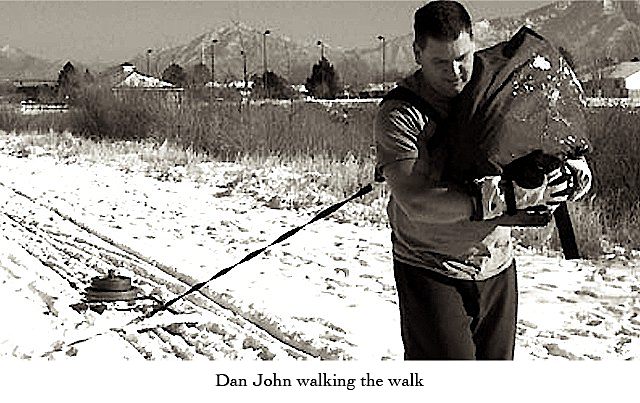
Strength coach Dan John has long been one of the movement's biggest advocates, describing loaded carries as one of the most valuable exercises a person can perform.
"Get back to me after doing these for three weeks. Obviously, your grip will be better. Your legs will be stronger. You'll discover the weight room isn't that tough anymore. You'll look leaner, but bigger."
Dan John — strength coachLoaded carries form a natural complement to the compound movements at the heart of the Minimum Effective Strength System — building the grip, core, and conditioning that makes every other lift more productive.
The moment you begin moving forward under load, the challenge
changes completely — every step becomes a single-leg exercise.
At this point, you might wonder whether squats and deadlifts already accomplish the same thing. Both exercises build tremendous strength and muscle. Both deserve a place in almost every serious training programme. However, walking with weights offers something unique. The moment you begin moving forward under load, the challenge changes completely. Every step becomes a balancing act. Your body must continuously adjust to shifting forces while remaining upright and stable.
This constant stabilisation challenge recruits muscles that often receive little attention during traditional gym exercises. As you walk, your core works relentlessly to resist twisting and bending. Your hips fire to keep you moving efficiently. The muscles along your sides help maintain balance and posture. In effect, each step becomes a single-leg exercise. This explains why loaded carries often improve athletic performance, balance, coordination, and functional strength in ways that conventional lifts cannot fully replicate. You are no longer simply lifting weight. You are carrying it through space while remaining strong, stable, and upright. That distinction matters.
Few exercises deliver so many benefits while requiring
so little equipment — or putting so little stress on the joints.
If you are a mature trainee, the benefits become even more impressive. One of the great challenges of ageing is preserving functional strength. Building bigger muscles is certainly worthwhile, but maintaining the ability to carry shopping bags, move furniture, climb stairs, and remain physically independent is arguably even more important. Walking with weights directly trains these real-world abilities.
For lifters over fifty, this combination of strength, conditioning, and joint-friendly movement is difficult to beat.
Research consistently identifies grip strength as one of the strongest predictors of healthy ageing — and loaded carries develop it more directly than almost any other exercise.
Strengthens the core without requiring endless crunches or complicated abdominal routines — the stabilisation demand is continuous and functional throughout every step.
Teaches the shoulders and upper back to remain stable under load — directly combating the rounded posture that modern sedentary life encourages.
Elevates the heart rate effectively without the repetitive joint pounding associated with jogging — making it an excellent conditioning tool for those managing knee or hip discomfort.
The real-world strength to carry, move, and lift things — the physical capability that determines quality of life and independence far more than any gym metric.
Total-body muscle engagement while walking creates a significant metabolic demand — contributing to body composition improvements alongside the strength benefits.
No specialised strongman equipment required.
A pair of dumbbells is more than enough to start.
The beauty of walking with weights is its simplicity. You do not need specialised strongman equipment. You do not need a fancy gym membership. You do not even need particularly heavy weights when starting out. A pair of dumbbells is more than enough.
Progress comes through consistency rather than complexity — the same principle that governs every productive training approach.
- Select a weight that challenges you while still allowing perfect posture — starting light is never a mistake
- Stand tall with your chest up and your abdominal muscles braced before taking the first step
- Take controlled, deliberate steps — resist the temptation to rush or shuffle awkwardly
- Maintain good posture from start to finish — the moment form deteriorates is the moment to stop
- Progress by increasing either the distance walked or the weight carried — there is no need to complicate matters beyond that
Modern fitness culture often tries to convince us that progress requires expensive equipment, complicated programmes, and endless exercise variations. Yet history repeatedly teaches a different lesson. The strongest men who ever lived built their physiques with remarkably simple tools. They squatted. They pressed. They deadlifted. And they carried heavy things. Walking with weights belongs firmly in that tradition. It is low-tech. It is brutally effective. And it develops the kind of practical strength that transfers directly into everyday life.
Start with a pair of dumbbells. Walk tall. Walk strong. Add a little distance each week and watch what happens. You may find your grip becomes stronger, your posture improves, your work capacity rises, and your entire body moves with greater confidence and power. Not bad for an exercise that consists of nothing more complicated than picking up a pair of weights and going for a walk.
Pick it up. Walk strong. Put it down. Repeat consistently. Loaded carries are one of the simplest additions to the Minimum Effective Strength System — and one of the most rewarding.