Benefits of Squats —
Deep Breathing Squats
1940s Style
How a barbell and a breathing technique transformed a dying man
How did deep breathing squats pluck 109-pound Roger Eells from his deathbed and transform him into one of the world's best built men? Reading like a Hollywood screenplay, his story remains one of the most compelling arguments for the squat ever written.
From a deathbed to one of the world's best built men.
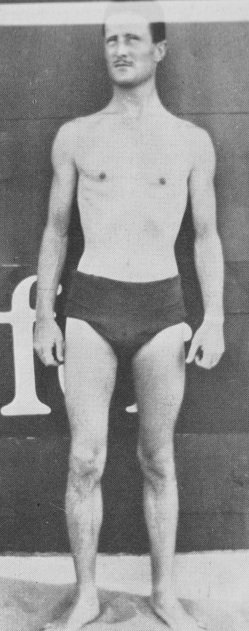
Roger Eells was born in a small US Midwestern town, the youngest of three brothers — and the smallest and weakest. Growing up on a diet of cakes and candy, he fell victim to every childhood illness and struggled to tip the scales at 93 pounds at age 14.
Despite his frailty, Eells had a burning desire to prove himself. He raced automobiles on dirt tracks and later took up aviation — to catastrophic results. Falling into a whirling propeller, he severed the muscles of his right thigh and punctured a lung. The resulting advanced tuberculosis left him with a collapsed lung and a prognosis of three months to live.
Eells was made of stern stuff. He spent the next year and a half slowly rebuilding his strength through walking. By 1932, weighing 121 pounds, he began progressive strength training with a barbell.
His left lung was still collapsed. His breathing was painful. Yet gradually he gained in weight and strength — until his sunken chest began to fill out and his neck and face began to take shape.
Initially he performed 20 rep squats without special attention to breathing — with average results. Then Joseph Curtis Hise visited and explained the importance of breathing squats and pullovers for building muscular size and strength. Everything changed.
What breathing squats produced.
- 12 months of breathing squats 41 pounds of bodyweight gained. Chest measurement increased by 10 inches. Shoulders widened by three inches. Six inches added to each thigh.
- Strength gains In December 1932 Eells struggled to lift 15 pounds. By 1933 he was lifting 850 pounds in the leg exercises and went on to one-arm press 250 pounds.
- By 1934 His collapsed lung had healed. His bodyweight had reached a muscular 185 pounds — up from 109 when he began.
The squat is the movement at the centre of the M.E.S. system's movement list — and for exactly the reasons Eells discovered. If this approach to training resonates, the Minimum Effective Strength System is built around it.
The breathing squats programme.
The deep breathing squats programme that produced this transformation had Eells squatting with 125 pounds for 20 repetitions, while eating as much as possible — including three quarts of milk with honey, peanut butter, and raisins daily. This fuelled the lung power necessary to grow and gain strength.
The technique itself is the critical element. Eells described it precisely.
"It must be fully understood that you are exercising on lung power. With this firmly in mind take the bar loaded to the weight that you have found from experimentation which will permit you to squat 20 times and take three deep breaths through your mouth. Suck in the air until you feel the pressure in your chest and then squat on full lungs rising, immediately expelling the breath on the way up. Take three more deep breaths and squat again on full lungs, rise and repeat 20 times, remembering to take three deep breaths between each squat and going down on full lungs."
Roger Eells"Three very deep breaths between squats and hitting bottom on full lungs is a very important part of the exercise so keep that in mind while performing it. If you experience a slight dizziness from the deep breathing disregard it for the first three exercise periods. If it persists it is a sign that you are not using enough weight. Do not, however, think that the heavier the weight you use, the more rapid results you will obtain. It is not the amount of weight you use but how you use it that encourages chest growth."
Roger EellsEells proved that a single movement, applied with focus and intent over time, produces extraordinary results. That is the same principle behind the Minimum Effective Strength System — fewer movements, repeated with purpose, for as long as it takes.