Best Full Body
Workouts —
From Yesteryear
Mass building routines that delivered outstanding gains for over half a century
The strongmen of yesteryear knew which routines guarantee strength and size increases. Using little more than a barbell and nutritious food, the following programmes have delivered outstanding gains for over half a century — and can do the same today.
The best full body workout must target all the major muscle groups in the most efficient manner possible, thereby triggering a maximum muscle building response. These three routines do exactly that.
29 pounds of muscle in one month.
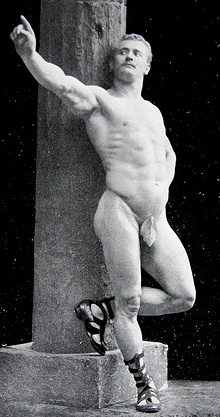
In the 1930s, J.C. Hise found his bodyweight stuck at an already considerable 200 pounds. Having attempted the standard routines of the day without progress, Hise read about the jaw-dropping results of Mark Berry and 20 rep squats.
He formulated his own mass building routine around the same principles. In one month he added 29 pounds of muscle. By the time he reached a bodyweight just short of 300 pounds, Hise had 19-inch arms, 39-inch legs, and a barrel chest measuring 56 inches.
Three exercises. 29 lbs in one month.
- 20 rep squats
- Press behind the neck
- Biceps curl
From 200 lbs to nearly 300 lbs. 19-inch arms. 56-inch chest. 39-inch legs.
From a deathbed to one of the world's
best built men.
The benefits of squats — deep breathing squats in particular — have long been recognised as a mass builder of the highest order. For 1940s Vim magazine editor Roger Eells, they produced something more remarkable still.
Following a propeller accident and a life-threatening bout of tuberculosis, Eells began training with barbells. Initially performing 20 rep squats without attention to breathing — with disappointing results — until Joseph Hise intervened and explained the secret of deep breathing squats. Everything changed.
Deep breathing squats helped Eells gain 35 pounds in one month — rocketing his bodyweight from a painfully frail 109 pounds to a muscular 185 pounds.
Four exercises. A complete transformation.
- Deep breathing squats
- Stiff leg deadlift
- Pullover
- Bench press
109 lbs to 185 lbs. 35 lbs gained in the first month alone. Collapsed lung healed. One of the world's best built men.
Squats, pulling movements, pressing movements — the same compound movement categories that form the basis of the Minimum Effective Strength System. Different names, same principles, same results.
25 pounds of muscle in three months.
The Hollywood transformation.
When actor Rick Jason walked into Willis Reed's gym in the 1950s, he stood six feet four and weighed 150 pounds. In three months of training under Reed's guidance, Jason gained 25 pounds of muscle, added an inch and a half to his collar size, three inches to his chest, and grew his biceps from twelve and a half inches to fifteen.
Built like a tank, Willis Reed designed a programme that trained the largest muscle groups to the maximum — the legs, chest, and back. Like Hise and Eells before him, Reed placed the deep breathing squat at the heart of the programme.
Four exercises. 25 lbs in three months.
- Squat
- Two arm pullover
- Regular deadlift
- Bent over barbell row
150 lbs to 175 lbs in three months. Collar +1.5 inches. Chest +3 inches. Biceps from 12.5 to 15 inches.
Three routines, three decades, three different men — all built around the same small number of compound movements applied with genuine effort and adequate recovery. That is the principle behind the Minimum Effective Strength System.