Dumbbell Workouts —
How They Built The
Strongest Man on Earth
The insider history behind your most underestimated training tool
Most people think of dumbbells as beginner equipment — the rusty pair in someone's garage, discarded in favour of a gym membership. What few trainees realise is how seriously effective a muscle building tool they actually are.
History proves it beyond any doubt.
A smoke-filled arena. Two men.
One title.
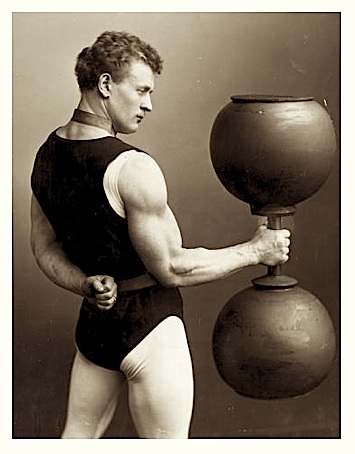
At the turn of the last century, in a smoke-filled Royal Aquarium in London, two men battled for one of the most coveted titles in strength sport — The Strongest Man on Earth.
The victor was a 22-year-old German whose physique was described as a living statue sculpted from marble. Unlike the typical strongman of his era, he performed with confident, modest authority that belied his youth. His lifts that evening included a clean and press from the shoulder of 250 pounds — a mark he would later better to 315 pounds — in addition to snapping an iron chain with the flexing of his chest.
What makes this story remarkable is not the lifts themselves. It is that this young German built his entire physique primarily using dumbbells.
That man was Eugene Sandow — the godfather of modern bodybuilding. A keen student of biology, he fashioned a system of training that was the first of its kind, built on two principles that remain as valid today as they were in 1890: consistent, progressive exercise.
His methods were later adopted by the armed forces with remarkable results. Soon the ordinary person in the street was applying this style of training to their own lives — which was precisely Sandow's aim. His cherished dream was that strength, health, and fitness be available to all.
What this style of training produces.
Sandow's students made gains that were considered spectacular even by modern standards — three to four inches added to a chest measurement, four to five inches removed from a waist — often achieved in weeks. Some of these results were produced using dumbbells weighing little more than five pounds.
The results were not products of the equipment. They were products of the principles.
- Fat loss through increased metabolic demand
- Muscle gain through progressive compound loading
- Improved strength across all movement patterns
- Increased endurance and work capacity
- Better health and general physical resilience
Sandow's two founding principles — consistency and progressive loading — are the same principles behind the Minimum Effective Strength System. The equipment changes. The principles do not.
Three dumbbell workout options.
Effective dumbbell workouts follow the same principles as traditional barbell training. The exercise selection should be compound movements — mass builders that cover the major muscle groups and yield the best results in the least time. Here are three options at different levels of abbreviation.
Four compound movements.
- Dumbbell rows
- Dumbbell press
- Dumbbell deadlift
- Dumbbell pullovers
Two movements. Total body.
- Dumbbell power clean and press
- Dumbbell pullovers
Two movements. Pull focus.
- Dumbbell deadlift
- Dumbbell pullovers
The abbreviated options above reflect exactly the kind of movement economy the Minimum Effective Strength System is built on — compound movements, deliberately selected, applied consistently. Sandow proved a century ago that this is enough.