Kettlebell Swing —
The Single Exercise
That Builds Strength
and Burns Fat
One set of 75 swings twice a week. Ten to twenty minutes of total weekly training time. Lowest body fat in years.
There are very few exercises that deliver as much training value per minute as the kettlebell swing. In a fitness landscape obsessed with variety, complexity, and endless programme changes, the swing stands as one of the most compelling arguments for simplicity. A single movement, performed correctly, that develops posterior chain strength, cardiovascular conditioning, hip power, grip, and core stability simultaneously — while burning significant calories and requiring nothing more than a single implement and open floor space.
The Russians have known this for over a century. The kettlebell — often described as a cannonball with a handle — was standard military training equipment long before it became fashionable in Western fitness culture. That longevity is no accident. The swing works. And it works with a directness and efficiency that most complicated modern training systems quietly envy.
75 swings. Twice a week. Lowest body fat
in years — in six weeks of ten-minute sessions.
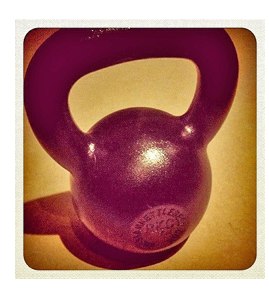
In The 4-Hour Body, Timothy Ferriss described a deliberately minimal kettlebell experiment. His goal was fat loss — specifically achieving visible abdominal definition. His protocol was stripped to its absolute minimum: one set of 75 swings performed twice a week, on Mondays and Fridays. Nothing else was added. Nothing else changed.
The minimum effective dose applied to fat loss — and it worked precisely because of its simplicity.
One set only. No supersets, no additional exercises, no complexity added.
Monday and Friday — adequate recovery between sessions, sustainable across six weeks.
Total weekly swing time: 10–20 minutes. The result: lowest body fat percentage in years.
The experiment illustrates the minimum effective dose principle perfectly — the smallest training stimulus that produces the desired adaptation. Not the maximum. Not the most exhausting. The most efficient.
The Ferriss result is not an anomaly. The kettlebell swing produces a metabolic response disproportionate to its apparent simplicity — because the hip hinge movement it is built around engages the largest and most powerful muscle groups in the body simultaneously. The glutes, hamstrings, erectors, and core all fire explosively during each repetition. The cardiovascular demand follows naturally from the muscular demand. Twenty minutes of hard swings taxes the system more thoroughly than many hour-long gym sessions.
The minimum effective dose. Brief. Demanding. Compound. The same principles behind the Ferriss experiment run through the Minimum Effective Strength System — every session doing precisely what is necessary and nothing beyond it.
The hip hinge — training the most powerful
movement pattern in the human body.
The kettlebell swing is fundamentally a hip hinge movement — the same pattern as the deadlift, the Romanian deadlift, and the good morning. The hips push back, the hamstrings load under stretch, and the glutes fire explosively to drive the hips forward. The kettlebell follows the trajectory of the hips rather than being muscled up by the arms. Understanding this distinction is the key to performing the swing correctly and extracting its full training value.
When performed with this hip-dominant mechanics, the swing develops the posterior chain — glutes, hamstrings, lower back, and erectors — in a way that is simultaneously conditioning and strength training. The ballistic nature of the movement builds explosive hip power that transfers directly to athletic performance and functional strength. The sustained metabolic demand of higher-rep sets develops cardiovascular capacity and muscular endurance without requiring separate cardio training.
One movement. One implement. More training return per minute than most full programmes.
Glutes, hamstrings, and spinal erectors trained explosively through a full hip hinge — the most neglected movement pattern in most modern training programmes.
High-rep swings elevate heart rate rapidly and sustain it — delivering meaningful cardiovascular training without a treadmill or dedicated cardio session.
The anti-extension demand of bracing against the swinging load develops functional core strength that sit-ups and crunches entirely fail to replicate.
Sustained grip under dynamic load builds forearm and hand strength that accumulates meaningfully across sets and sessions.
The explosive hip drive that powers each swing develops the same athletic quality as Olympic lifting — without the technical complexity or spinal loading.
The combination of large muscle recruitment, metabolic demand, and post-exercise oxygen consumption makes the swing one of the most calorie-efficient exercises available.
Kettlebells are measured in poods —
an old Russian unit that still defines the standard sizes.
Kettlebells are traditionally measured in poods — an old Russian unit of weight equalling 16 kilograms or approximately 35 pounds. This measurement system has produced a natural set of standard training weights that remain in common use. Choosing the right starting weight matters because the swing must be performed with hip-dominant mechanics throughout — too light and the movement becomes arm-dominant, too heavy and form breaks down and injury risk rises.
Start lighter than you think necessary. The swing humbles most trainees on first contact.
One pood. The standard starting recommendation for women beginning kettlebell training.
One and a half poods. The recommended starting weight for average-sized men new to the swing.
The standard issue size in the Russian military — the progression target for experienced male trainees.
The swing is far more demanding than it appears. Most people accustomed to conventional weight training significantly underestimate the cardiovascular and muscular demand of a properly performed set of twenty or more repetitions with a moderately heavy kettlebell. Starting lighter, learning the hip hinge mechanic correctly, and building volume gradually is the approach that produces lasting results rather than an embarrassing first session followed by days of inability to sit down.
Hip hinge — not a squat, not a shoulder raise —
the mechanical distinction that determines everything.
The most important thing to understand before attempting the kettlebell swing is that it is a hip hinge, not a squat. The hips push back, the torso tilts forward, and the power comes from driving the hips forward explosively — not from squatting up or raising the arms. The arms are merely a link between the hips and the kettlebell. They do not power the movement. The hips do.
Master the hip hinge first. Every other element of the swing follows from it.
- Set the kettlebell on the floor about a foot in front of you. Stand with feet shoulder-width apart, toes slightly turned out
- Hinge at the hips — push the hips back, maintain a neutral spine, and reach forward to grip the handle with both hands
- Tilt the kettlebell toward you so the handle is at an angle — this loads the lats and prepares the backswing
- Hike the kettlebell back between the legs powerfully — as if hiking a rugby ball — with the forearms making contact with the inner thighs
- Drive the hips forward explosively, squeezing the glutes hard at the top — the kettlebell floats up to shoulder height as a consequence of hip power, not arm effort
- Let the kettlebell swing back down, hinge again to absorb the load, and repeat the hip drive immediately for the next repetition
- At the top position, stand tall — hips fully extended, glutes squeezed, core braced — for a brief moment before the bell descends
Common errors are almost always variations of the same mistake — using the arms and shoulders to raise the kettlebell rather than driving with the hips. If the lower back is doing most of the work, the hips are not hinging sufficiently. If the arms are tired before the glutes and hamstrings, the hip drive is insufficient. The correction is always the same: think about the hips, not the bell.
The swing is the sparkling jewel in the kettlebell training crown. One movement that scorches fat, builds posterior chain strength, develops cardiovascular conditioning, and trains the explosive hip power that transfers to everything else — in ten to twenty minutes of weekly work.
Brief. Compound. Demanding. Recoverable. The kettlebell swing shares every principle of the Minimum Effective Strength System — and makes an excellent addition to any abbreviated training week that needs conditioning without the recovery cost of traditional cardio.