Deadlift Exercise —
The Greatest Overall
Growth Movement
A total body exercise on a par with the squat — and equally demanding of respect
The deadlift is a total body exercise on a par with its nearest neighbour, the squat. Few movements in strength training produce as much whole-body adaptation for the effort invested. Two of the most respected authorities in the field have been unequivocal about it.
Mike Mentzer and Stuart McRobert
on the deadlift.

"The deadlift is the greatest overall growth exercise as it works every muscle on the backside of the body, from the Achilles tendon to the occiput of the head. Deadlifts also work the deltoids, the forearms, and just about every muscle in the body."
Mike MentzerMentzer's assessment is not hyperbole. The deadlift's reach across the entire posterior chain — combined with the grip, core, and upper back demands it places on the trainee — makes it arguably the single most productive movement available with a barbell.
"Doing high intensity bent-legged or stiff-legged deadlifts no more than once a week is a big step towards making big gains from these movements — and a big step towards injury-free training."
Stuart McRobertMcRobert's point on frequency is the essential practical companion to Mentzer's case for the movement. The deadlift's potency is precisely why it demands careful management — train it too often and the recovery cost exceeds the adaptive benefit.
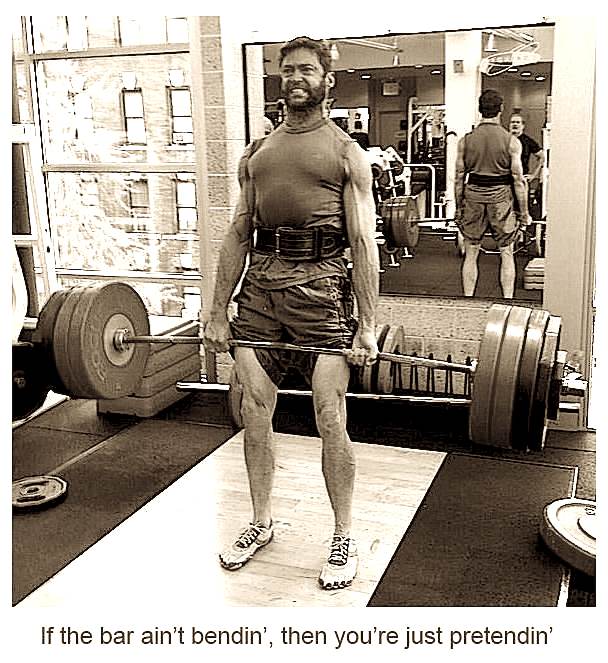
The deadlift is one of the primary movements in the Minimum Effective Strength System — applied with precisely the frequency and recovery management McRobert describes.
Three ways to apply the deadlift.
-
Frequency — once per week maximum
Stuart McRobert recommends working the deadlift hard once per week for greatest gains, adding weight to the barbell slowly and consistently. For some trainees even this proves too much. If progress stalls or recovery suffers, extend to once every ten days or once every two weeks. This is where abbreviated training proves its value — less frequency, not more, is the correct response to a stalling deadlift.
-
Squat swap — make the deadlift your anchor movement
Many trainees have found excellent results from replacing the squat exercise with the deadlift as the cornerstone of their training. Replacing one proven mass builder with another makes excellent sense for any trainee pressed for time or with limited recovery capacity. The deadlift covers similar muscle groups with a different demand on the body — and for some trainees, it produces better results than the squat.
-
Technique — respect the movement
Proper deadlift technique is non-negotiable. The deadlift performed poorly will almost certainly cause injury — the lower back is the most vulnerable structure and the most common casualty. Learn the movement correctly before loading it heavily, and it will protect you as much as it develops you. Show the barbell deadlift well-earned respect, and increased mass and strength will follow.
If the deadlift as a primary movement — applied infrequently, loaded progressively, with full recovery between sessions — resonates with how you want to train, the Minimum Effective Strength System builds that approach into a complete framework.