Hindu Squat —
How to Hindu Squat
in 3 Simple Steps
The ancient Indian wrestlers' exercise — no equipment, aerobic conditioning, and a reputation for strengthening the knees
The Hindu squat is one of the oldest exercises in the world. Practised by Indian wrestlers for centuries, it demands no equipment, can be performed anywhere, and produces a conditioning effect that most modern aerobic machines fail to replicate. It also has an unusual reputation — one that a knee injury and a dusty library book brought to light.
A knee injury, a library book,
and the Great Gama of India.
The discovery came by accident — a knee injury sustained while running, which put an end to morning training sessions and made the exercise bike genuinely painful and kneeling something close to intolerable. Standard recovery methods were not working and a different approach was needed.
The answer was in a library book pushed to the back of the shelves. The story it contained detailed how this exercise had originated in ancient India as a foundational movement for wrestlers — a source of both strength and endurance that had been practised for generations. The exercise had a further reputation: that it possessed certain healing properties, and specifically that it could safeguard and strengthen the knees rather than stress them.
A tentative exploration of the movement began. Over several months, the ability to perform deep knee bends returned — without pain. Kneeling became comfortable. Stamina improved as a pleasant additional benefit. Later research confirmed that this experience was not unusual. The claims about the Hindu squat and knee health are consistent across multiple independent accounts.
The most famous practitioner —
500 Hindu squats daily, undefeated in 5,000 matches.
The most celebrated practitioner of the Hindu squat in history was Ghulum Mohammed — known throughout the wrestling world as the Great Gama. His daily training volume and competitive record established the Hindu squat's reputation as a foundational strength and endurance exercise in the Indian wrestling tradition.
Indian National Champion 1909. Retired undefeated after 5,000 matches.
- Daily Hindu squat training volume 500 repetitions
- Competitive matches — career total Over 5,000
- Career record Undefeated
- Indian National Champion 1909
The Great Gama's 500 daily Hindu squats were not a conditioning supplement to his wrestling training — they were a central pillar of it. The endurance, leg strength, and knee resilience that the movement developed were considered foundational requirements for any serious wrestler in the Indian tradition.
The Hindu squat is the aerobic complement to the progressive strength training approach of the Minimum Effective Strength System — bodyweight conditioning that requires no equipment and can be performed on rest days from barbell work without adding meaningful recovery cost.
The benefits of the Hindu squat —
aerobic, structural, and practical.
The Hindu squat produces a combination of benefits that is difficult to replicate with a single exercise. Unlike the conventional barbell squat — which primarily develops maximal strength through progressive loading — the Hindu squat develops aerobic capacity, muscular endurance, coordination, and the knee-joint resilience that makes it useful both as conditioning work and as rehabilitation.
- Aerobic conditioning without equipment — sustained repetitions elevate the heart rate into the aerobic zone without the impact of running or the cost of a machine
- Knee strengthening — the movement pattern strengthens the musculature surrounding the knee joint, including the muscles and connective tissue most often implicated in knee pain
- Muscular endurance — high-repetition sets develop the capacity of the leg muscles to sustain repeated effort, complementing the maximal strength developed by barbell work
- Improved flexibility — the full-depth movement progressively develops ankle, knee, and hip mobility
- Cardiovascular fitness — consistent practice raises aerobic capacity and improves the cardiovascular efficiency that supports all other training
- No equipment, no gym, no restrictions — the exercise can be performed in any space large enough to stand in
For the complete account of Hindu squat benefits — including the knee health research — see the Hindu squats benefits page.
How to Hindu squat —
three steps to correct technique.
The technique is straightforward but specific — the arm movement, breathing pattern, and rhythm that distinguish the Hindu squat from a conventional bodyweight squat are all deliberate and each serves a purpose. Follow all three steps and the movement will feel natural within a few sessions.
-
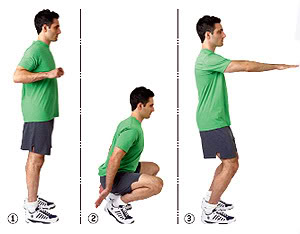
The descent — down onto the toes
Begin standing with feet approximately shoulder-width apart. As you descend into the squat, rise onto the balls of your feet — the heels lift off the floor as you go down. This is the key mechanical distinction from the conventional squat, where the heels stay planted. The arms swing back and down to brush the ground at heel level at the bottom of the movement. As you descend — breathe out, exhaling fully.
-
The ascent — arms sweep upward
From the bottom position, drive upward through the legs. As you rise, sweep the arms forward and upward in a wide arc, bringing them up to chest height with palms facing down. The arm movement adds momentum to the ascent and creates the flowing, continuous rhythm that characterises correct Hindu squat technique. As you ascend — breathe in, inhaling deeply.
The breathing pattern — reversed from the conventional squatMatch breath to movement precisely.
Squat down Breathe OUTRise up Breathe IN -
The rhythm — relaxed and continuous
The whole movement flows in a continuous, relaxed, metronome-like rhythm — not a strength exercise with rest between repetitions, but a steady, sustainable pace that can be maintained for two to three minutes. The movement is aerobic by nature and the rhythm should reflect that — unhurried, consistent, breath and movement matched throughout. On completing your set, jog lightly on the spot for a further minute to bring the heart rate down gradually. Performed on alternate mornings, this is sufficient to build a genuine foundation of aerobic fitness alongside your strength training.
Two to three minutes of Hindu squats on alternate mornings — no equipment, no gym, no cost. Alongside progressive barbell training, this is the complete conditioning framework. The Minimum Effective Strength System covers the barbell side. The Hindu squat covers the rest.