Set Up a Home
Gym Like the
Old-Time
Strongmen
The strongest men who ever lived built their bodies without chrome-plated machines, electronic consoles, or thousands of pounds worth of equipment
Walk into a modern commercial gym and you could be forgiven for thinking strength is built by machines. Everywhere you look there are chrome-plated contraptions, electronic consoles, cable stations, and selectorised weight stacks. Yet for all this complexity, something important has been lost along the way. The strongest men who ever lived built their bodies without any of it.
Long before fitness chains and social media influencers existed, men such as Eugene Sandow, Arthur Saxon, George Hackenschmidt, and Hermann Goerner developed extraordinary strength in simple halls, back rooms, garages, and makeshift gymnasiums — their feats remaining legendary more than a century later. If these pioneers could build powerful muscular bodies with minimal equipment, why do so many modern trainees believe they need thousands of pounds worth of gear before they can begin?
A well-developed physique was the natural consequence
of becoming stronger — not the sole objective.
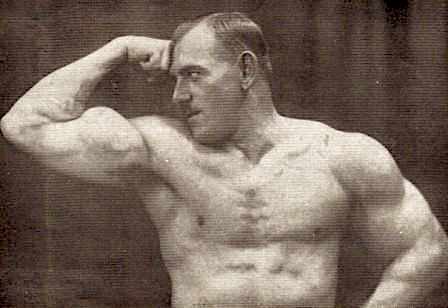
The physical culture movement of the late nineteenth and early twentieth centuries produced some truly remarkable athletes. Unlike modern bodybuilding, which often places appearance above performance, these men trained primarily for strength and athletic ability. A well-developed physique was viewed as a natural consequence of becoming stronger rather than the sole objective.
Arthur Saxon, perhaps the greatest one-arm lifter in history, built his world-famous strength using basic free-weight exercises. George Hackenschmidt combined wrestling excellence with impressive feats of lifting power. Eugene Sandow became one of the most admired physiques on earth using little more than progressive resistance training and sensible nutrition. What all these men shared was a belief in simplicity. Their routines revolved around a handful of productive exercises. Their training equipment was uncomplicated. Their focus remained fixed on becoming stronger.
Strength does not require complexity. It requires consistency. The old-time strongmen understood this before the fitness industry existed to complicate it.
The same simplicity that built legendary physiques in makeshift gymnasiums drives the Minimum Effective Strength System — a handful of productive compound movements, progressive loading, and adequate recovery. Nothing more required.
Four items. Every major muscle group trained.
Progress possible for years without a single upgrade.
If Arthur Saxon were building a garage gym today, he would probably laugh at the amount of equipment many people believe is necessary. In reality, a remarkably small collection of tools provides everything required for building strength and muscle. The best home gym is not necessarily the largest or most expensive. It is the one you use consistently.
Combined, these four items allow you to perform every major compound lift and train productively for decades.
The cornerstone. With a barbell alone you can squat, press, deadlift, row, and clean. Unmatched versatility. Buy quality once and it lasts a lifetime.
A sturdy rack dramatically expands exercise options while improving safety — the single most important structural addition to any home gym.
Combined with the rack and barbell, an adjustable bench provides everything needed to perform the major compound lifts that built generations of strong men.
The most honest measure of relative strength. A chin-up bar adds the complete pulling movement the barbell alone cannot replicate — and your gym is virtually complete.
They taught the body to function as a coordinated unit —
not a collection of isolated parts.
The old-time strongmen did not spend their workouts hopping between a dozen isolation exercises. Instead they focused on movements that delivered the greatest return on effort — exercises training large amounts of muscle simultaneously, teaching the body to function as a coordinated unit rather than a collection of isolated parts. This is one reason why many old-time strongmen looked so athletic. Their training developed real-world strength rather than merely gym-specific abilities.
Every one of these can be performed with the four essential pieces of equipment above.
Powerful legs, hips, and lower back trained simultaneously. The foundation of lower-body strength.
Impressive shoulders, triceps, and upper-body pressing strength — the old-time strength athlete's primary upper-body lift.
Tremendous pulling power while strengthening nearly every muscle in the body. Nothing else comes close.
Thick backs and powerful arms — the pulling counterpart to the press that keeps the shoulders balanced and healthy.
Horizontal pressing strength — chest, shoulders, and triceps trained under a load the overhead press cannot replicate.
Grip strength, endurance, and functional power in a single movement. A favourite of the old-time strongmen for good reason.
Iron plates do not become obsolete — and a sturdy rack
performs its job just as well twenty years from now.
One of the great advantages of creating a home gym is that it can be assembled gradually. You do not need to purchase everything at once. Many excellent bargains can be found second-hand — unlike most consumer products, strength-training equipment often lasts for decades. Your training space does not need to be glamorous either. Some of the most productive gyms in history have existed inside garages, sheds, spare bedrooms, and garden outbuildings. The environment matters far less than the effort invested within it.
Begin immediately. Improve gradually. The best setup is always the one you are already using.
- Start with adjustable dumbbells — an excellent beginning that allows immediate productive training with almost no space requirement and minimal outlay
- Add a barbell and plates — the single greatest upgrade available, unlocking squats, deadlifts, presses, and rows with one investment
- Complete with a squat rack, bench, and chin-up bar — transforming a modest training area into a complete strength facility that rivals any commercial gym for the movements that matter most
A blueprint that worked one hundred years ago
and works just as well today.
The old-time strongmen left behind more than impressive photographs and extraordinary lifting records. They left behind a blueprint for effective training. Build your strength around productive exercises. Focus on progressive overload. Train consistently. Recover adequately. Avoid unnecessary complexity.
If you have been waiting for the perfect circumstances to begin training at home, consider this your invitation to stop waiting. You do not need a commercial gym. You do not need fancy machines. You do not need a room filled with expensive equipment. You need a few well-chosen tools, a willingness to work hard, and the patience to improve steadily over time.
That was enough for the old-time strongmen. And if it was enough to build some of the strongest physiques in history, there is every chance it will be enough for you too.
The best home gym is not the largest or the most expensive. It is the one you use consistently — with intent, with effort, and with the patience to let progress accumulate over time.
Four items. Six movements. Progressive loading applied consistently. The old-time strongmen had the blueprint — and the Minimum Effective Strength System provides the modern programme that applies it.