Hex Bar —
Three Training Tips
from Pro Athletes
A painful lower back led to one of the most versatile training tools available
Not everyone can squat or deadlift with a conventional barbell. Lower back pain, mobility limitations, or the absence of a spotter make these movements inaccessible for many trainees — and that means missing out on the most productive exercises available.
The hex bar solves that problem. Here is where it came from and how to use it properly.
Al Gerard and the invention
of the trap bar.
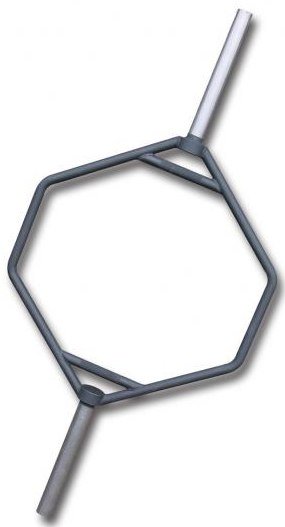
The hex bar was the invention of Al Gerard — a North Carolina powerlifter who suffered from a painful lower back that prevented him from training the deadlift productively.
Gerard's solution was to create a parallel-handled frame to stand inside while lifting, rather than pulling a bar from in front of the body. His reasoning was precise: by distributing the weight more in line with the body's natural centre of gravity, the lower back would no longer be the weak link in the deadlift. The stress would transfer to the legs, hips, and posterior chain where it belonged.
The result confirmed his theory. Not only did Gerard's lower back respond well — his strength gains extended to the squat, his traps grew substantially, and his grip improved. The trap bar had earned its place.
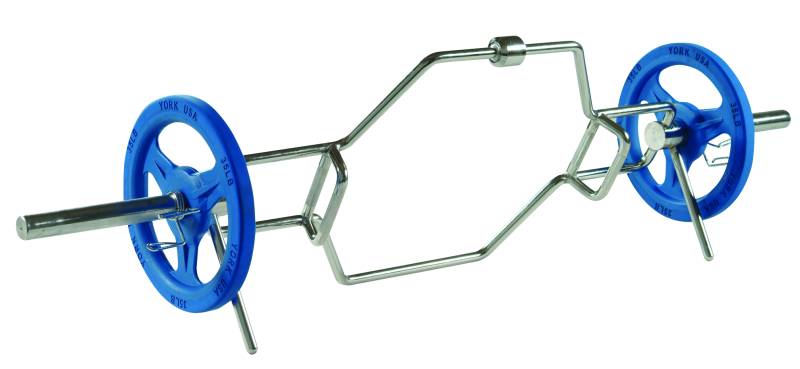
One design modification. Multiple improvements.
- Lower back removed as the limiting factor in the deadlift
- Weight distributed through the body's natural centre of gravity
- No barbell in front of the body — no forward pull on the spine
- Neutral grip handles reduce wrist and forearm strain
- Safe for solo home training — no risk of being trapped under the bar
How to train with the hex bar.
-
Safe, effective, and solo-friendly
The first thing you notice using the hex bar is stability. Unlike the barbell squat, there are no balance concerns, no spotter requirements, no risk of being trapped under a failing lift. You stand inside the frame, grip the handles, and drive — pushing with the legs while the lower back is protected throughout. For the home gym trainee working alone, this makes it one of the most practical muscle building exercises available. One focused set is all that is required to initiate the growth response — the movement is that demanding when applied properly.
-
Apply intensity with caution
The hex bar deadlift is simultaneously one of the safest and one of the most demanding exercises you will perform. Because of this, training to failure is not advisable — the goal is to build the body, not exhaust it. Cycle your intensity progressively as you add weight to the bar. For a structured approach to high-repetition hex bar work, the 20 rep deadlift protocol applies directly. Combine the hex bar deadlift with the dip and the chin up, and you cover all major muscle groups with three movements.
-
Use it for single-leg loading
The hex bar's versatility extends well beyond the standard deadlift. For single-leg loading — lunges, split squats, step-ups — it is arguably the best implement available. Where dumbbells become awkward to hold at heavy loads and a barbell on the back creates balance complications, the hex bar sits neutrally at the sides and allows genuine loading without grip or stability becoming the limiting factor. Try hex bar lunges with a weight that challenges you — the leg development from unilateral loading at this intensity is exceptional.
The hex bar deadlift — one focused set, maximum stimulus, lower back protected — is the kind of efficient, sustainable movement the Minimum Effective Strength System is built around.
If squats and deadlifts have been causing lower back pain, the hex bar removes the barrier between you and the most productive movements available. Make it the linchpin of your training and the gains will follow.
If training safely and effectively with a minimal equipment setup resonates with how you want to build strength, the Minimum Effective Strength System includes the hex bar as one of its recommended movement alternatives — designed for exactly this situation.