Building Muscle
While Losing Fat
After 50 — The
Recovery-Based
Approach
Body recomposition remains achievable after fifty — but the strategy changes completely
Few topics in fitness create more confusion than the idea of building muscle while losing fat. Mainstream fitness culture often presents body recomposition as some brutal war of attrition requiring starvation diets, endless cardio sessions, and punishing six-day workout routines. The message is that success comes from suffering harder than everyone else while surviving on minimal food and maximum effort.
For trainees over fifty, this approach frequently ends in disaster. The body becomes exhausted. Joints ache. Energy crashes. Sleep deteriorates. Motivation fades. Worse still, many mature trainees begin losing valuable muscle tissue alongside body fat — leaving themselves smaller, weaker, and increasingly frustrated despite all their effort.
The truth is that body recomposition remains entirely achievable after fifty. But the strategy required changes dramatically. After fifty, successful muscle-building and fat loss depend less upon punishment and far more upon intelligent recovery management.
Sarcopenia, metabolism, and the cycle
that makes fat loss harder without intervention.
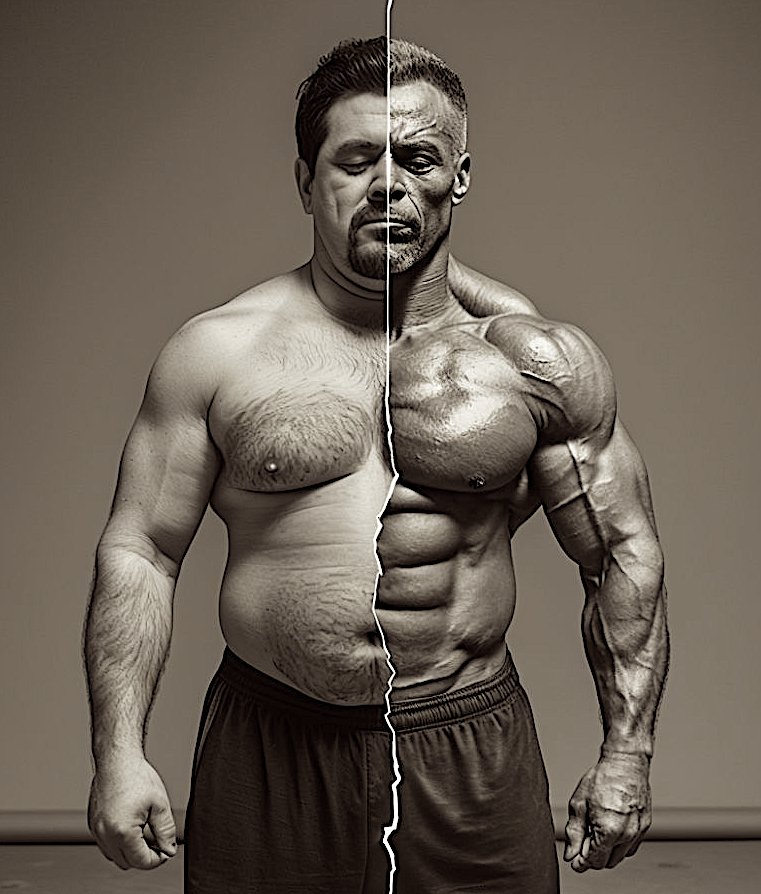
The human body changes gradually with age whether we acknowledge it or not. Recovery slows. Hormonal output declines. Muscle tissue becomes easier to lose and harder to regain. Activity levels often decrease while stress levels increase through work pressures, financial responsibilities, and family obligations. Metabolism also begins shifting — and a major contributor to that shift is the gradual loss of lean muscle mass known as sarcopenia.
Since muscle tissue is metabolically active, losing muscle means the body burns fewer calories at rest. This creates a compounding cycle — the less muscle a person carries, the slower the metabolism becomes. The slower the metabolism, the easier body fat accumulates. And the more body fat accumulates, the harder movement, exercise, and recovery feel. For the full picture on how body composition changes without intervention, see the body fat percentage page.
Yet despite these challenges, the situation is far from hopeless. The body remains highly adaptable well into later life. Mature trainees can absolutely become leaner, stronger, and more muscular. But achieving this requires abandoning the reckless "train harder and eat less" mentality so aggressively promoted by modern fitness culture. After fifty, sustainability becomes everything — the body responds best not to extremes, but to intelligent consistency.
The goal is no longer forcing the body into submission. The goal becomes working with the body intelligently enough that it can consistently adapt, recover, and improve.
Body recomposition after fifty — building muscle while reducing fat — is the central promise of the Minimum Effective Strength System. Progressive compound training that preserves and builds lean muscle while supporting the metabolic conditions that allow fat loss to occur alongside it.
Crash diets, excessive cardio, and the
muscle loss that makes recomposition harder.
One of the biggest mistakes older trainees make is becoming overly aggressive with fat loss. Crash diets may produce rapid scale weight reductions, but they often come with serious consequences. Severe calorie restriction drains energy, disrupts recovery, increases muscle loss, and elevates stress hormones. When combined with excessive cardio and high-volume training, the body quickly begins breaking down faster than it can repair itself — and this is particularly dangerous after fifty, when muscle tissue becomes increasingly valuable.
Many mature trainees unknowingly sacrifice hard-earned muscle while trying desperately to lose fat. The scales may temporarily move downward, but metabolism slows further as lean tissue disappears. Strength declines. Recovery worsens. Energy levels collapse. The result is a smaller but softer physique accompanied by greater fatigue and frustration — not the leaner, stronger body the effort was intended to produce.
Excessive cardiovascular training compounds this problem. It often interferes with recovery reserves already limited by age, stress, and everyday life demands — trapping the body in a constant state of exhaustion rather than adaptation. Successful body recomposition after fifty therefore requires balance. The objective is not losing weight at all costs. The objective is preserving and ideally building lean muscle while gradually reducing excess body fat.
Muscle as the fat-burning furnace —
and why abbreviated training serves it best.
If there is one factor that transforms body recomposition after fifty more than any other, it is strength training. Resistance exercise sends the body an enormously important signal — this muscle is still needed. That signal matters because muscle tissue acts as the body's metabolic engine. The more lean muscle a person carries, the higher their resting metabolic rate tends to be.
Muscle is the fat-burning furnace — and strength training is the only tool that builds and preserves it.
- Raises resting metabolic rate — more muscle means more calories burned at rest, around the clock
- Improves insulin sensitivity — muscle is the body's primary glucose disposal site, directly supporting fat loss
- Preserves strength and mobility — the functional qualities that make fat loss sustainable rather than damaging
- Supports bone density — particularly critical after fifty when bone loss accelerates without resistance training
- Produces the hormonal environment that favours fat loss — progressive strength training elevates testosterone and growth hormone relative to cortisol
This is why abbreviated strength training works so well for mature trainees pursuing recomposition. Rather than overwhelming the body with marathon gym sessions, minimalist routines focus on highly productive compound movements — squats, rows, presses, deadlifts, and carries — performed with consistency and progressive effort. Shorter workouts reduce joint stress and nervous system fatigue, allowing recovery reserves to remain intact. And after fifty, preserving recovery ability becomes critical. Many trainees discover they build better muscle — and lose fat more effectively — once they stop trying to exhaust themselves with excessive training volume. The body responds beautifully to focused, manageable stress. It rarely responds well to constant punishment.
The habits outside the gym that determine
whether recomposition actually happens.
One of the great mistakes in modern fitness culture is treating workouts as the entire transformation process. In reality, body recomposition depends just as heavily upon recovery habits outside the gym — and for the over-50 trainee, this is where many of the most significant gains are made or lost.
The transformation happens outside the gym as much as inside it.
Muscle tissue requires amino acids for repair and growth. Adequate daily protein — at least 1.6 g per kg of bodyweight — is non-negotiable for preserving lean tissue during a fat loss phase.
Directly affects hormonal regulation, appetite control, tissue repair, and recovery capacity. Poor sleep is one of the most consistent saboteurs of recomposition progress at any age.
Supports fat loss gently and sustainably without taxing recovery ability. Improves cardiovascular health, aids circulation, reduces stress, and enhances recovery — the ideal complement to strength training.
The body does not distinguish between gym stress and life stress. Work anxiety, financial worries, poor sleep, and excessive training all compete for the same finite recovery reserves.
Influences energy, recovery, joint function, and nutrient delivery. Consistently underestimated as a variable in both training performance and fat loss.
Small, consistent deficits — 200 to 300 calories below maintenance — allow fat loss to proceed without the muscle loss, hormonal disruption, and energy crashes that aggressive restriction produces.
Walking deserves particular attention because it remains one of the most underrated tools available for mature trainees. Unlike exhausting cardio routines that compete directly with recovery, walking supports fat loss gently and sustainably. It is also the most consistently maintainable form of additional movement available — which matters enormously, because the best fat-loss strategy after fifty is rarely the most extreme one. It is usually the one you can consistently maintain for years. For the measurable outcomes of daily walking, see the 10,000 steps page.
Consistency beats intensity —
especially over the long haul.
Another major challenge facing mature trainees is impatience. Modern fitness culture encourages unrealistic expectations — dramatic transformations in weeks rather than meaningful progress sustained across years. When results fail to arrive quickly enough, many trainees panic and begin jumping between extreme diets, exhausting workout plans, and unsustainable routines. This constant inconsistency becomes incredibly damaging, because the body thrives on steady, progressive effort.
Mature trainees who focus on sustainability often achieve far better physiques precisely because they avoid the destructive boom-and-bust cycles so common in modern fitness culture. Their joints remain healthier. Their recovery stays manageable. Their energy remains stable. Most importantly, they continue training consistently while others burn out and quit. This is one of the hidden advantages of training intelligently after fifty — patience becomes a genuine competitive edge.
The real objective after fifty is not simply becoming lighter. It is building a body that remains lean, strong, capable, and resilient for the decades still ahead. That requires muscle, movement, intelligent nutrition, and above all — recovery. Because after fifty, recovery is no longer secondary to transformation. Recovery becomes the very thing that makes transformation possible.
Forget the reckless fitness extremes.
Forget the starvation diets.
Forget the endless cardio marathons.
Build muscle patiently.
Lose fat intelligently.
Create a physique strong enough to carry you through the rest of your life.
Muscle. Movement. Nutrition. Recovery. These four things — applied with consistency and patience — produce the body recomposition that punishment and extremes never deliver. The Minimum Effective Strength System is the structured framework for putting all four into practice.