Muscle Building
Exercises —
3 Keys from the 1930s
The strongmen of yesteryear knew which exercises yield the best results
The strongmen of the 1930s produced results that still seem extraordinary — trainees gaining 20 pounds of muscle in less than a month becoming legendary accounts. To discover the best exercises for muscle building, we turn a reverential eye to the past.
J.C. Hise, Peary Rader,
and the formula that worked.
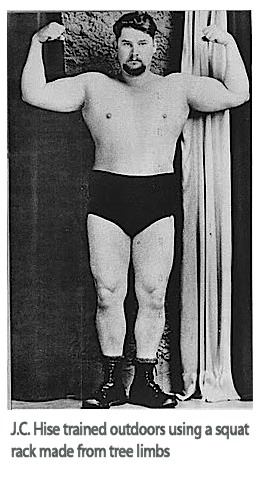
The story begins with a 128-pound, 5'10" Peary Rader — frustrated after twelve years of strength training with little to show for it. Hearing of the extraordinary gains made by J.C. Hise, Rader contacted him directly.
Hise had been doing nothing but the squat exercise and presses behind the neck — and gained 29 pounds in one month. These gains were corroborated and verified by Mark Berry. Hise went on to document his formula precisely.
Heavy breathing squats + wholesome food + milk + rest = incredible growth in muscular size and strength.
Hise also trained outdoors using a squat rack made from tree limbs braced against the wall of a shed — proving that the simplest equipment, used effectively, produces startling results.
Three exercises. Seventy pounds
of muscle in two years.
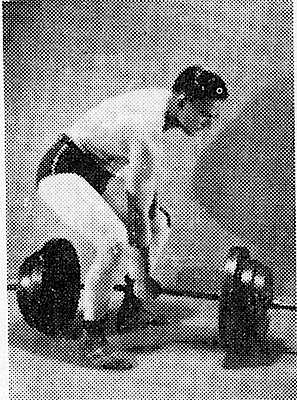
Inspired by Hise's results, Rader applied the same approach with three movements. Despite his previous poor gains after more than a decade of training, the results were immediate.
The later founder of Iron Man Magazine trained on this alone.
- Squat exercise
- Chin up
- Press behind neck
First month: 10 pounds of good muscle. Two years: 70 pounds of total bodyweight gained. Rader went on to become heavyweight lifting champion of the Midwestern AAU district, including South Dakota, Nebraska, and western Iowa.
Three movements, applied consistently with progressive effort — this is the exact structure behind the Minimum Effective Strength System. The exercises change; the principle does not.
The top three muscle building exercises.
An effective strength training routine must include exercises that stimulate maximum growth across all the major skeletal muscles in the minimum time. The following three movements have proven themselves across generations of serious lifters.
-
Deadlift or Olympic clean and jerk
The deadlift is a supreme growth exercise — it works every muscle on the backside of the body, including the deltoids, forearms, and virtually every other major muscle group. For those wanting an alternative, the Olympic clean and jerk produces comparable whole-body stimulation with the addition of explosive power development.
-
Close-grip pulldown or chin up
The chin up works the latissimus muscles of the back, the deltoids, and the forearms — and is the most effective exercise available to build bigger biceps. A close-grip pulldown serves the same function for those who cannot yet perform chin ups.
-
Parallel bar dip
The dip will do for your upper body what the squat does for your whole body. This proven mass builder works the pectorals, deltoids, traps, and triceps simultaneously — making it one of the most efficient upper body movements available.
The deadlift, chin up, and parallel bar dip are drawn from the same movement library as the Minimum Effective Strength System — built around movements that produce maximum adaptation for the effort invested, just as the strongmen of the 1930s knew they did.