Mike Mentzer Routines
Heavy Duty bodybuilding heresy — and why it works
Hero or heretic? Mike Mentzer was a proponent of High Intensity Training as developed by Nautilus creator Arthur Jones. His analytical mind led him to challenge everything bodybuilding orthodoxy held sacred — and the results proved him right.
His Heavy Duty system attracted a devoted following that included six-time Mr Olympia Dorian Yates. It still influences serious lifters today.
A free-thinking analytical mind in a world of volume training.
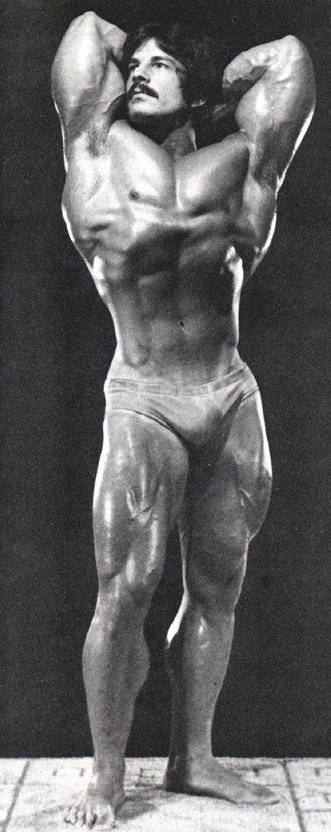
When a typical muscle building workout consisted of many exercises, multiple sets, and sessions that often lasted hours, Mentzer's Heavy Duty methods were viewed with suspicion by the bodybuilding establishment.
The suspicion could not last. The science underpinning his methods — and the results they produced — found a dedicated following. His influence on the science of muscle building endures.
For a while, many in the bodybuilding world considered Mentzer's work heresy. In time, his scientific principles were embraced by the wider populace — resulting in a legacy befitting this remarkable man.
Stress. Recover. Grow.
Train less as you get stronger.
Heavy Duty training works on the premise that for a muscle to grow it must first be significantly stressed. Following that stress, the fatigued muscle must enjoy a period of recovery — which in due course leads to growth.
The most startling aspect of Heavy Duty in its most stripped-down form is its frequency. A typical Heavy Duty routine looks like this.
- SetsOne set per exercise
- VolumeOne exercise per body part
- Recovery3–5 days between sessions
- IntensityTrained to failure
Can so little exercise produce such significant gains? Mentzer argued — and proved — that it can. Overtraining is often the biggest mistake a lifter can make. Slowdowns in progress are rarely the result of training too little. They are almost always the result of training too much.
Mentzer's central argument — train less as you grow stronger, protect recovery above all else — is one of the philosophical foundations of the Minimum Effective Strength System.
Dynamic physiology and changing training requirements.
Writing in Heavy Duty II, Mentzer stresses the importance of dynamic physiology — the body is in a continual process of change. As an individual grows stronger, their training requirements change too.
"Once the fundamentals of intensity, volume and frequency are understood, this issue of changing training requirements follows as the most crucially important issue in exercise science."
Mike Mentzer — Heavy Duty IIAs you build muscle and lift heavier weights, the stresses on your body grow greater and must be compensated for. Mentzer advised that as you grow stronger over time, inserting an extra rest day or two would fully compensate the recovery process — until eventually the trainee is exercising once every six to seven days or less.
The conclusion is direct: you must train less as you grow bigger and stronger. Not as a temporary measure — as a permanent principle.
Mike Mentzer's Heavy Duty routine.
The importance of rest time between workouts led Mentzer to develop the following programme. Consisting of two workouts — A and B — each containing two exercises, trained just once per week. If you train Workout A on Monday, you train Workout B the following Monday, and so on.
- Smith Machine Squats — 8–15 reps
- Chin Ups — 6–10 reps
All sets trained to failure. One set per exercise.
- Barbell Deadlift — 5–8 reps
- Parallel Bar Dip — 6–10 reps
Alternate with Workout A on a weekly basis.
The brevity of the programme is not accidental. When you grow stronger as a result of training, the stresses on your body grow proportionally. You must compensate by allowing adequate rest and recovery. Train before you have sufficiently recovered and you short-circuit the muscle building process entirely.
If Mentzer's argument resonates — that less training, applied with genuine intensity, produces better results than more — the Minimum Effective Strength System builds that argument into a complete, practical framework.