How to Build
Bigger Biceps
Why the musclemen of the 1950s knew something most gym-goers still miss
Walk into any gym and you will see the same thing — trainees performing barbell curls in the belief it is the most effective route to bigger arms. The musclemen of the 1950s would disagree. Science backs them up.
There is a more efficient way to build bigger biceps. It is called the chin up.
19-inch arms. 200 pounds weighted.
Built with chin ups.
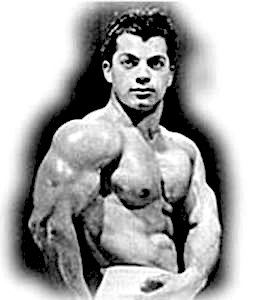
In the decade when a hip-swivelling Elvis Presley drove young girls into a screaming frenzy, the musclemen of the era were building remarkable arms through a different kind of performance entirely.
One strongman stood head and shoulders above his peers. Marvin Eder — The Biceps from the Bronx — built arms measuring a shirt-splitting 19 inches and routinely performed chin up repetitions with a staggering 200 pounds of additional weight.
The chin up was not a secondary movement for Eder. It was a primary one. And the results spoke for themselves.
The chin up is traditionally considered an upper back exercise — and it is. What most trainees miss is that it is simultaneously the most efficient biceps exercise available, more effective than any curl variation.
One joint axis versus two.
Why the chin up wins.
The biomechanical case for the chin up over the curl is straightforward once you understand what is happening at the muscle level.
One joint axis
The biceps muscle is worked around a single joint — the elbow. This places the predominant stress on the lower portion of the biceps only, leaving the upper portion comparatively underworked.
Two joint axes
The biceps is worked around both the elbow and the shoulder simultaneously. This works the muscle more uniformly from both ends — producing a more complete and efficient biceps stimulus with every repetition.
The chin up also works the latissimus dorsi, the deltoids, and the forearms in the same movement. As the pull up exercise — performed with a palms-facing grip — it also connects to the bent over barbell row as part of a complete pulling movement family.
The conclusion is clear. If you want to build big biceps efficiently, the chin up produces more return for the effort invested than any curl variation. The 1950s musclemen knew this intuitively. Science explains why.
The chin up is one of the primary pulling movements in the Minimum Effective Strength System — chosen precisely because it produces the most return across the most muscle groups for the effort invested.
The musclemen of the 1950s knew which exercises were the proven mass builders. Follow their example — add the chin up to the centre of your training — and bigger biceps will follow as a consequence of becoming genuinely stronger.
If training with movements that produce maximum adaptation across multiple muscle groups resonates with how you want to approach strength, the Minimum Effective Strength System is where that philosophy lives in full.