Bruce Lee Fitness —
How to Train Like
Bruce Lee
Six exercises. Maximum results from the most economical expenditure of energy.
Bruce Lee was not only a martial artist and movie star — he was a student of exercise science who amassed a personal library of over 2,500 books including the writings of the great strongmen of history. His thirst for knowledge drove him to test every exercise in his routine for its actual efficacy.
The result was a workout programme of deliberate economy that served him from 1965 until 1970.
A library of 2,500 books.
Every exercise tested for efficacy.
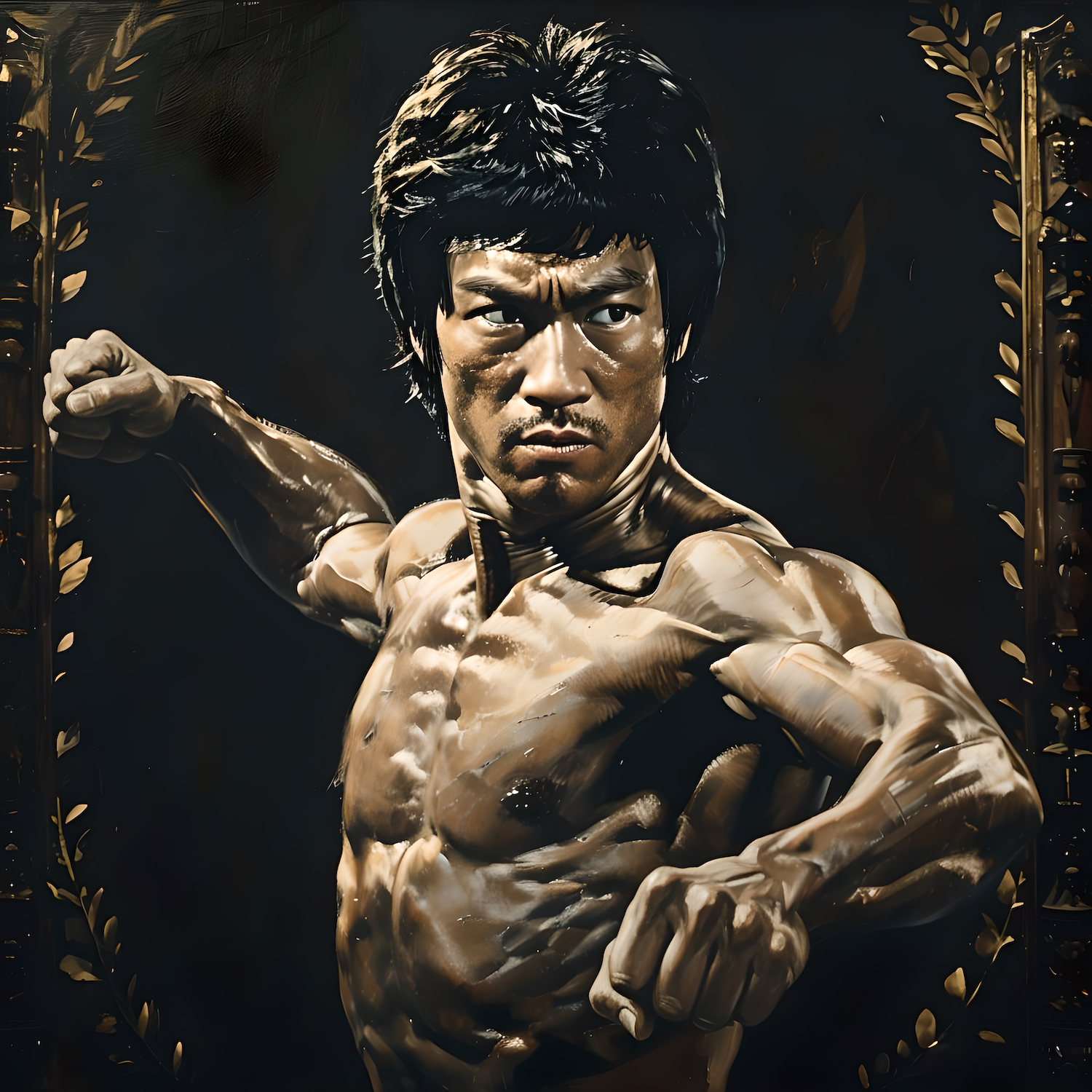
Lee trained all elements of total fitness — muscular strength, muscular endurance, cardiovascular endurance, and flexibility. His library included not just contemporary exercise science but the strongmen of yesteryear, including Eugene Sandow.
This attention to detail meant every movement in his programme had earned its place. Armed with just a handful of exercises, Lee trained not only his muscles but the strength of connective tissues — ligaments and tendons. The Bruce Lee body was not concerned with muscle size. What mattered was training for function.
What this approach produced.
Lee placed special emphasis on arm strength and conditioning. His training produced results that remain remarkable by any standard.
- Single biceps curls with over 70 pounds
- One-armed chin-ups for 50 repetitions
- Static contraction holds — 125 pounds at arm's length
- Custom-built grip equipment and extensive wrist curl work
This desire to maximise physical potential saw Lee constantly evolve his weight training until he settled on the following workout.
The Bruce Lee barbell workout.
This routine served Lee from 1965 until 1970 — five years of consistent application. It fitted perfectly with his philosophy of getting maximum results from the most economical expenditure of energy.
Six exercises. Two sets. 8–12 repetitions.
Performed with deliberate economy — brief, functional, focused on the basics.
- Clean & Press
- Squats
- Pullovers
- Bench Press
- Good Mornings
- Barbell Curls
After diligent research of all available strength training literature, Lee concentrated on the basics to transform his body — the same proven basics that have underpinned serious strength training for a century.
Six carefully chosen exercises, two sets each, focused entirely on function over volume. This is the same philosophy at the heart of the Minimum Effective Strength System — maximum results from the minimum effective stimulus.
The squat at the centre of everything.
Of all six movements, the squat was the cornerstone of Lee's barbell training. He accumulated dozens of articles expounding the merits of this mass builder and performed it in strict, standard fashion for two sets of 8–12 repetitions.
Those same articles championed the benefits of squats combined with pullovers. While there is no direct evidence Lee supersetted the two, there is every reason to believe it is likely — pullovers were considered a productive rib box expander and effective accompaniment to deep breathing squats. Just as J. C. Hise and Roger Eells had demonstrated before him, Lee took full advantage of this combination.
Unlike the marathon routines prevalent at the time, Lee's approach was brief and targeted. Training for function meant no wasted movement, no excess volume, no complexity beyond what the goal required.
Lee's training philosophy — test everything, keep only what works, eliminate the rest — is the same discipline behind the Minimum Effective Strength System. If that approach to training resonates, that is where it lives in full.