How to Build
Chest Muscles —
The Case for the
Parallel Bar Dip
The bench press built some of the greatest physiques in history — and the parallel bar dip may be a better chest builder still
The bench press is the dominant chest exercise in virtually every gym in the world. Its credentials are beyond dispute — the physiques it has built, the strength records it has produced, and the generations of trainees who have used it as the foundation of their upper body development all testify to its effectiveness.
The case for the parallel bar dip is not that the bench press should be abandoned. It is that the dip — which predates the bench press by decades and was once far more widely used — deserves recognition as an equally potent, and in some respects superior, chest-building tool. The case rests on history, mechanics, and the testimony of some of the strongest people who have ever trained.
Before the bench press dominated —
two lifters, two extraordinary numbers.
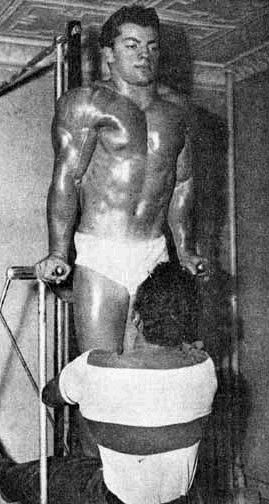
Before the bench press became the default chest exercise in the 1950s, the parallel bar dip was one of the primary upper body pushing movements in serious strength training. The transition happened not because the dip was found to be inferior — it happened because adjustable benches became standard gym equipment and the bench press offered a more straightforward way to measure and compare pressing strength.
- Doug Hepburn — bench press, 1954 580 lbs
- Marvin Eder — parallel bar dip with added weight 434 lbs
- Marvin Eder's bodyweight at the time of the dip 198 lbs
- Total load in Eder's dip — bodyweight plus added weight 632 lbs
Hepburn's 580-pound bench remains one of the most celebrated upper body strength achievements in the pre-drug era of strength training. But the numbers behind Marvin Eder's dip are equally extraordinary — 434 pounds of added weight, on top of a 198-pound body, for a total load of 632 pounds pressing through the parallel bar dip pattern. The dip was not a secondary exercise for these men. It was a primary instrument of upper body development.
For the full account of Marvin Eder's extraordinary credentials, see the Marvin Eder page. For the Doug Hepburn training method and his unique approach to building strength, see the Doug Hepburn method page.
The parallel bar dip — alongside the squat, deadlift, and press — forms one of the core compound movements at the heart of the Minimum Effective Strength System. Its historical credentials are as strong as any upper body exercise available.
Why the dip earns its place —
the muscles it recruits and the range it covers.
The parallel bar dip's claim to superiority over the bench press as a chest builder rests on two specific mechanical advantages — muscle recruitment breadth and range of motion depth.
The same primary muscles — with meaningful differences in recruitment and range.
Pectorals — primary
Anterior deltoids
Triceps
Range limited by chest contact with bar
Fixed movement path — bar dictates arc
Pectorals — primary
Anterior deltoids
Triceps
Greater range — full shoulder extension
Natural movement arc — body dictates path
The dip's range of motion advantage is significant. The bench press is limited by the bar reaching the chest — the pectorals never fully stretch beyond that point. In the parallel bar dip, the body descends below the bar level, allowing the pectorals to stretch through a greater range before the pressing movement begins. A muscle trained through a fuller range of motion generally develops more completely than one trained through a partial range under fixed external constraints.
The dip also allows the body to find its own natural pressing arc rather than being constrained by a fixed bar path. This natural movement suits many trainees' shoulder geometry better than the fixed horizontal path of the barbell bench press — particularly relevant for older trainees managing accumulated shoulder history.
The observation that the dip does for the upper body what the squat does for the lower body is not casual hyperbole. It reflects the exercise's capacity to recruit multiple upper body muscle groups simultaneously through a demanding, full-range movement that develops the chest, shoulders, and triceps as an integrated system rather than in partial isolation.
The bench press and the parallel bar dip are not competing exercises — they are complementary ones. Between them they cover the full spectrum of upper body pressing development. The trainee who masters both is considerably better equipped than the one who relies on either alone. For the complete technique guide and progressive loading framework, see the parallel bar dip page.
Compound movements that recruit the maximum muscle mass across the greatest functional range — this is the operating principle behind both the dip and the Minimum Effective Strength System. The dip earns its place in any serious pressing programme alongside the bench press, not instead of it.