Easy Abdominal
Exercises for
Over 50 — Build
Core Strength
Without Hurting
Your Back
Effective core training after fifty has nothing to do with punishment — and everything to do with stability, posture, and longevity
Modern fitness culture has turned abdominal training into a strange form of punishment. Brutal killer ab workouts, endless crunch challenges, high-speed circuits, and social-media influencers promising six-pack abs through sheer exhaustion. For younger trainees, this approach is often merely uncomfortable. For many people over fifty, traditional abdominal routines become something far worse — painful.
Lower-back irritation. Tight hip flexors. Neck strain. Aching joints. These problems frequently appear when mature trainees follow aggressive abdominal programmes designed more for spectacle than long-term physical health. As a result, many simply abandon core training altogether. That is unfortunate, because abdominal strength becomes increasingly important as we age.
Effective abdominal training after fifty should not revolve around punishment, endless repetitions, or chasing cosmetic perfection. It should revolve around functionality, spinal support, posture, movement quality, and resilience.
The core as central stabilising system —
structural, protective, and functional.
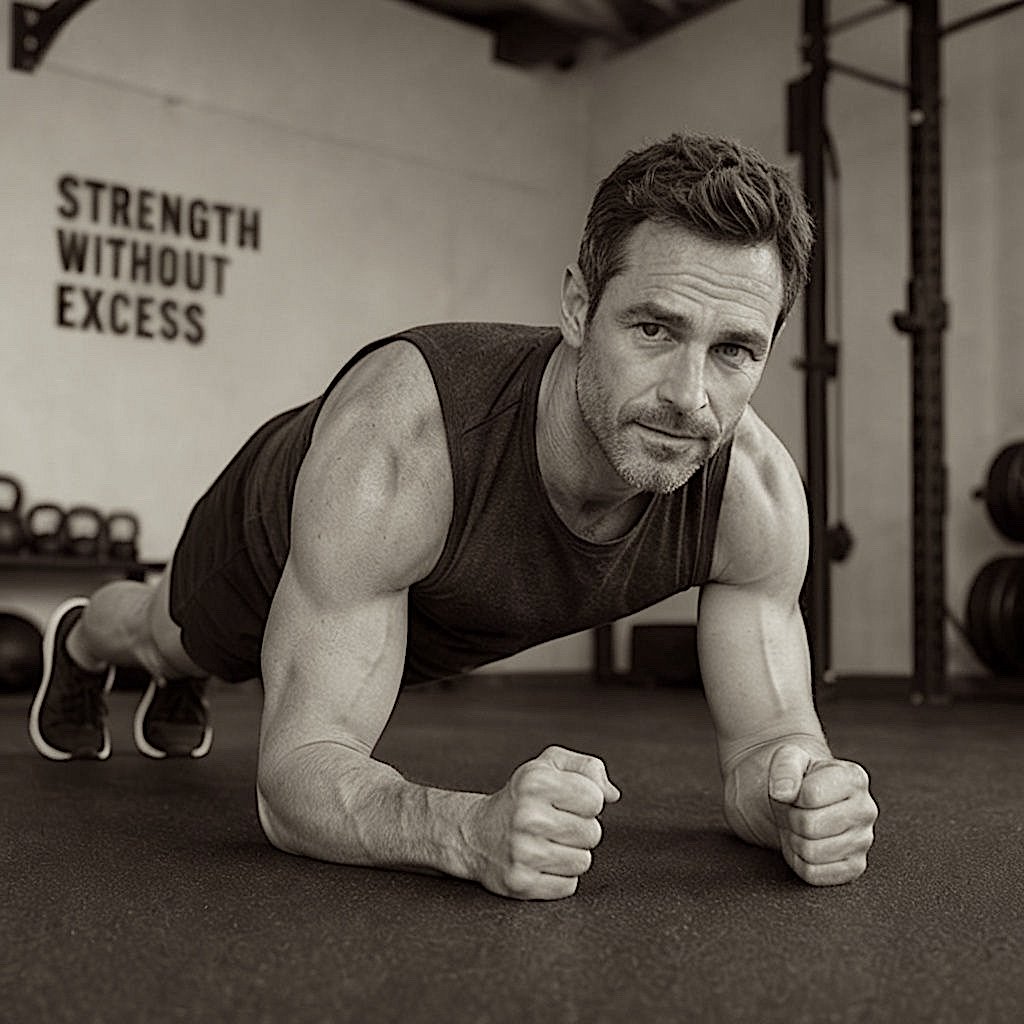
The abdominal muscles do far more than simply influence appearance. The core acts as the body's central stabilising system — the muscles surrounding the abdomen, lower back, pelvis, and trunk working together to support posture, protect the spine, transfer force, and stabilise movement during both exercise and everyday life.
This becomes critically important after fifty. Ageing naturally brings gradual reductions in muscle mass, mobility, and recovery capacity. Sedentary lifestyles compound the problem further. Long hours spent sitting at desks, driving, or looking at screens weaken the abdominal wall while simultaneously tightening the hips and stressing the lower back. Over time, posture deteriorates. Movement becomes less efficient. Balance may decline. Even simple daily activities — lifting shopping bags, climbing stairs, standing for extended periods — begin placing greater strain on the body.
A strong core helps resist this decline. Proper abdominal training supports healthier posture by stabilising the spine and pelvis. It improves balance and coordination. It enhances lifting mechanics. And perhaps most importantly, it creates a more stable and resilient foundation for movement itself. This is why abdominal training after fifty should never be viewed as merely cosmetic. It is structural. It is protective. And it directly contributes to long-term physical capability.
The core's primary function is not to produce movement but to resist it — resisting collapse under load, resisting unwanted rotation, resisting extension when fatigued. The exercises that develop this capacity are rarely the ones that appear most impressive in a gym.
Core strength supports every compound movement in the Minimum Effective Strength System — the squat, deadlift, press, and row all require the trunk to stabilise under genuine load. For the complete core training framework including the bracing technique, see the best core exercises page.
Repeated spinal flexion under fatigue —
and why the hip flexors usually do the work.
Many conventional abdominal exercises were never designed with ageing bodies in mind. Traditional sit-ups and high-volume crunch routines repeatedly force the spine into flexion under fatigue. While this may create a temporary sensation in the abdominal muscles, it can also place considerable stress on the lower back, neck, and hip flexors — particularly when performed excessively or with poor mechanics.
This is one reason many over-50 trainees experience discomfort during abdominal workouts. Very often, the abdominal muscles themselves are not doing most of the work. Tight hip flexors frequently dominate the movement while the lower back absorbs repetitive strain. Add speed, momentum, and fatigue into the equation, and the result becomes less core training and more repetitive irritation of structures that were not designed to be loaded in this way continuously.
More repetitions do not produce better abdominal development either. Endless high-repetition abdominal work often becomes an exercise in endurance rather than meaningful strength-building. The core's primary function is stabilisation — it exists to resist unwanted movement, support posture, and transfer force safely throughout the body. Intelligent core training therefore focuses less on mindless repetition and more on controlled tension, stability, and coordination. For mature trainees especially, preserving spinal health should always remain the priority.
Joint-friendly abdominal exercises —
selected for the over-50 trainee's specific needs.
Effective abdominal training does not require complicated equipment or punishing workouts. Some of the best core exercises for mature trainees are simple, controlled movements that strengthen the midsection while minimising unnecessary joint and spinal stress. The key throughout is quality, not speed — not exhaustion, and certainly not mindless repetition.
-
The plank
Performed correctly, the plank teaches the abdominal wall to stabilise the spine while developing endurance throughout the core musculature. Rather than repeatedly bending the spine, the movement trains the body to resist collapse and maintain alignment under sustained tension. A properly braced plank — with the glutes engaged, the hips level, and the entire body forming a rigid line — produces considerably more genuine core stimulus than three minutes of slack-form endurance holding. Twenty seconds of maximum tension is worth more than three minutes of drifting concentration. Progress by increasing the quality and density of the hold rather than simply extending the duration.
-
Dead bug
One of the most effective deep-core exercises available for mature trainees, and one of the most joint-friendly. Lying on the back with arms extended toward the ceiling and knees bent at ninety degrees, the trainee lowers one arm and the opposite leg toward the floor simultaneously while keeping the lower back pressed firmly against the ground. The trunk must work continuously to prevent the lower back from lifting as the limbs descend. This anti-extension challenge develops the deep stabilising muscles — the transverse abdominis and the multifidus — that support spinal health but are rarely addressed by crunches. Begin with slow, controlled repetitions and focus entirely on preventing any lower back lift throughout.
-
Bird dog
From a quadruped position — on hands and knees — extend one arm forward and the opposite leg backward simultaneously, holding for two to three seconds before returning. The movement develops balance, coordination, spinal control, and the posterior chain stability that protects the lower back during lifting. For the over-50 trainee managing lower back discomfort, the bird dog is one of the most consistently recommended therapeutic core exercises available — it strengthens without loading the spine in a compromised position. Keep the hips level throughout and avoid letting the lower back arch as the leg extends.
-
Farmer's carries
Particularly valuable for mature trainees because the training demand is directly functional rather than isolated. Carrying heavy dumbbells, kettlebells, or a loaded trap bar at arm's length while maintaining upright posture places tremendous demands on the core, grip, shoulders, and stabilising muscles simultaneously. The abdominal wall must work continuously to resist rotation and maintain spinal alignment throughout the walk — producing a deep trunk stimulus that transfers directly to everyday carrying tasks. Suitcase carries — a single implement in one hand — add unilateral challenge that directly addresses the lateral stability the obliques provide. For the complete carry framework including the Robert Sparkman quarter-mile sandbag carry approach, see the sandbag training page.
-
Standing band press
Anchor a resistance band at chest height and press both hands forward to arm's length, holding briefly before returning. The movement challenges the core's ability to resist rotation and extension against a pulling load — mimicking the functional demand of real-world pushing tasks while keeping the spine in a safe, neutral position throughout. Unlike floor-based exercises, the standing band press trains the core in the upright position it must function in during daily life and compound lifting. It also develops the anterior deltoids and triceps alongside the core stabilisers, making it one of the more efficient movements available for the time-conscious trainee.
The core is not separate from the rest —
it is the foundation every other movement runs on.
One of the greatest misconceptions in fitness is believing the abdominal muscles exist separately from the rest of the body. In reality, every serious strength movement depends heavily upon core stability. Squats, deadlifts, presses, rows, carries, and bodyweight exercises all rely upon the abdominal wall to stabilise the spine and transfer force efficiently. Without sufficient core strength, energy leaks throughout the kinetic chain. Posture collapses. Technique deteriorates. Injury risk rises.
This is why strong abdominals matter so much to mature lifters. The core functions less as a cosmetic show muscle and more as the body's central support structure. When properly developed, the abdominal wall creates safer and more powerful movement patterns throughout the entire body. And this strength carries over directly into daily life — lifting groceries, carrying luggage, climbing stairs, rising from chairs, maintaining balance during awkward movement. Functional strength begins at the centre.
Short, focused, and sustainable —
core training that fits within abbreviated programming.
One of the biggest mistakes mature trainees make is assuming abdominal training requires huge volumes of work. It does not. In fact, excessive abdominal volume often becomes counterproductive. After fifty, recovery ability is one of the most valuable resources in all of training. The body still responds extremely well to intelligent exercise, but it no longer tolerates endless punishment without consequences. Marathon ab circuits and daily high-volume core sessions often create unnecessary fatigue while providing very little additional benefit.
Short, focused core sessions performed consistently work far better. A few carefully selected exercises executed with concentration and proper tension produce excellent results while preserving recovery reserves and protecting the joints. This abbreviated approach fits perfectly within minimalist strength training philosophy — the same principle of maximum stimulus, minimum recovery cost, applied to the core rather than the barbell.
Remember, the goal is not surviving an abdominal endurance event. The goal is building a stronger, healthier, and more resilient body over the long term. And sustainability always matters more than intensity for its own sake. A powerful midsection is not forged through punishment. It is built patiently, intelligently, and consistently — one strong, controlled repetition at a time.
Effective abdominal training after fifty is not about chasing perfection. It is about preserving movement quality, spinal support, balance, posture, and physical capability for the decades still ahead. Core strength protects the body from the gradual physical decline modern sedentary life encourages — and it allows strength training itself to remain productive and sustainable as the years progress.
Planks, dead bugs, bird dogs, carries, and band presses — five exercises that build the core strength every other movement in the Minimum Effective Strength System depends upon. Not six-pack chasing. Not abdominal punishment. Structural strength, built intelligently, for the long term.